
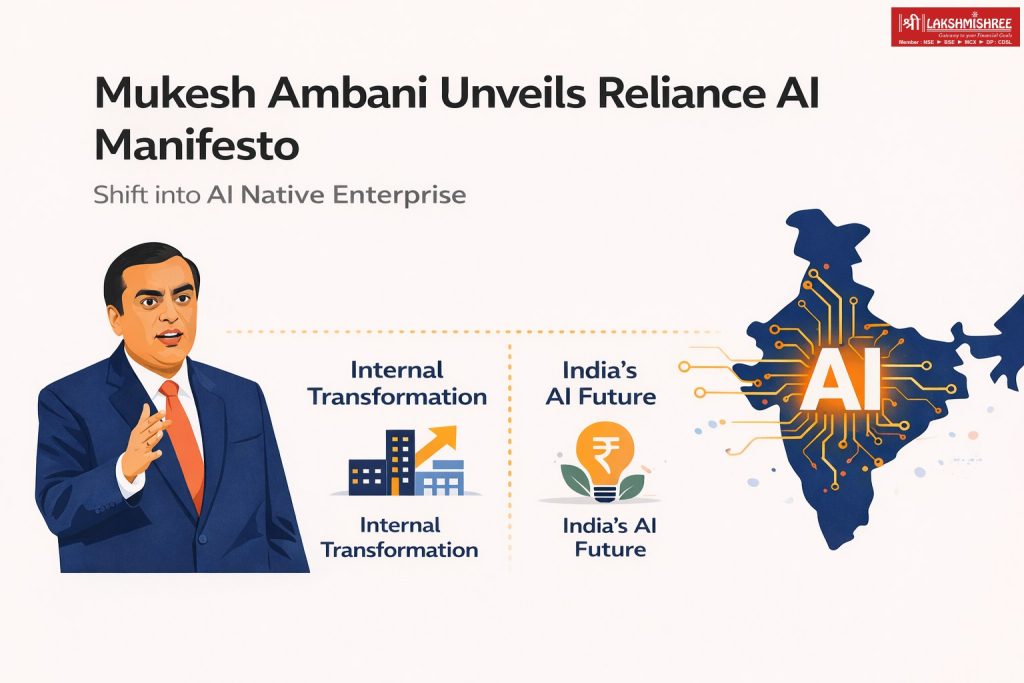
Reliance Ltd has laid out its most ambitious technology vision yet, as Chairman Mukesh Ambani unveiled a draft Reliance AI Manifesto, positioning artificial intelligence as the central force shaping the company’s next phase of growth and India’s broader technological transformation.
Calling AI “the most consequential technological development in human history,” Ambani said the world has so far witnessed only a fraction of AI’s potential. He emphasised that when deployed responsibly, AI has the power to solve some of humanity’s most complex challenges—ranging from productivity and sustainability to healthcare, education, and inclusion.
The draft manifesto, shared internally across the group, invites employees to critique and enrich the vision before it is finalised later this month. This collaborative approach signals that Reliance Ltd’s AI strategy is not a top-down technology rollout, but a foundational shift in how the organisation thinks, works, and creates value.
From Digital Pioneer to AI-Native Enterprise
Over the past decade, Reliance Industries Limited has been synonymous with India’s digital transformation—most notably through Jio, which democratised internet access by delivering the world’s lowest data costs at scale. The AI manifesto positions this legacy as only the starting point.
Ambani described Reliance’s next ambition as becoming an “AI-native deep-tech company with advanced manufacturing capabilities.” Unlike firms that merely layer AI tools onto existing processes, an AI-native organisation embeds intelligence at the core of decision-making, workflows, and platforms.
Central to this vision is Reliance’s stated resolve: “Affordable AI for every Indian.” Much like affordable data reshaped India’s digital economy, Reliance aims to ensure that AI capabilities are accessible across income levels, industries, and geographies—aligning corporate strategy with national priorities of inclusion and self-reliance.
Reimagining Work Inside Reliance Ltd Through AI
The first part of the Reliance AI manifesto focuses on internal transformation, outlining how AI and agentic systems will fundamentally redesign work across the group’s diverse businesses, spanning energy, telecom, retail, financial services, media, life sciences, and manufacturing.
Ambani stressed that the goal is not indiscriminate automation, but removing friction, reducing repetitive manual effort, improving decision quality, and raising organisational standards, while remaining safe, compliant, and trusted.
To achieve this, Reliance proposes a clear operating rhythm built around four pillars:
- Outcomes: Work will be organised around clearly defined outcomes such as customer experience, safety, speed, quality, cost efficiency, compliance, and growth, with progress continuously measured and made visible.
- Workflows: End-to-end processes—from procurement and supply chains to hiring and factory operations—will be redesigned with AI embedded at every stage, eliminating “digital breaks” and enabling real-time visibility.
- Platforms: A common 12-layer digital functional core will guide platform design across businesses, with data as the foundational layer and AI as the acceleration layer, ensuring scalability and interoperability.
- Governance: AI governance will be embedded by design, with audit trails, digital policies, and clear human accountability to ensure speed does not compromise trust or integrity.
To sustain continuous improvement, Reliance plans to run five weekly AI flywheels: real-time data, real-time operations, real-time governance, learning and knowledge systems, and AI-driven automation with human oversight.
Work will increasingly be organised through small, cross-functional “pods,” each with a single objective and a clearly accountable leader—allowing rapid experimentation, scaling, and stable operations without sacrificing reliability.
Reliance Ltd’s Broader Role in India’s AI Transformation
The second part of the manifesto looks beyond Reliance’s internal operations to India’s AI future, outlining how the group’s scale and ecosystem can help drive national transformation.
Ambani invited ideas on how Reliance’s vast platforms—including Jio’s 500-million-strong subscriber base and Reliance Retail’s nationwide footprint—can expand AI access and impact across sectors. Opportunities highlighted include AI-driven healthcare breakthroughs, green energy and advanced materials, financial inclusion, indigenous AI hardware, robotics, and next-generation manufacturing.
A key theme is technology sovereignty. By investing in AI infrastructure, hardware, and platforms within India, Reliance aims to reduce external dependencies and strengthen domestic capabilities in critical technologies.
Ambani also underscored the role of Reliance Foundation, asking how AI could further enhance its work in healthcare, education, rural transformation, disaster mitigation, culture, and conservation while reflecting the group’s long-standing “We Care” philosophy through the development of “caring AI systems.”
Why the Reliance AI Manifesto Matters
What sets the Reliance AI manifesto apart from conventional corporate AI announcements is its system-level ambition. Rather than treating AI as a productivity tool or cost lever, Reliance frames it as a civilisational technology, one that must balance intelligence with empathy, speed with governance, and scale with responsibility.
By inviting employees to co-create the manifesto, Ambani is signalling that AI transformation is as much cultural as technological. The final document, expected after internal submissions between January 10 and January 26, is likely to serve as a long-term blueprint guiding Reliance Ltd’s strategy across the next decade.
As India enters a new phase of economic and technological development, Reliance’s AI push could influence not just corporate adoption, but also how large enterprises think about ethical AI, inclusion, and national competitiveness.

Kaashika is a social media strategist and financial content creator at Lakshmishree. She specialises in simplifying complex IPO and stock market concepts into clear, easy-to-understand content. Having created over 500+ pieces of financial content across reels, blogs, website posts and digital creatives, Kaashika helps audiences connect with the world of finance in a more accessible and engaging way.