
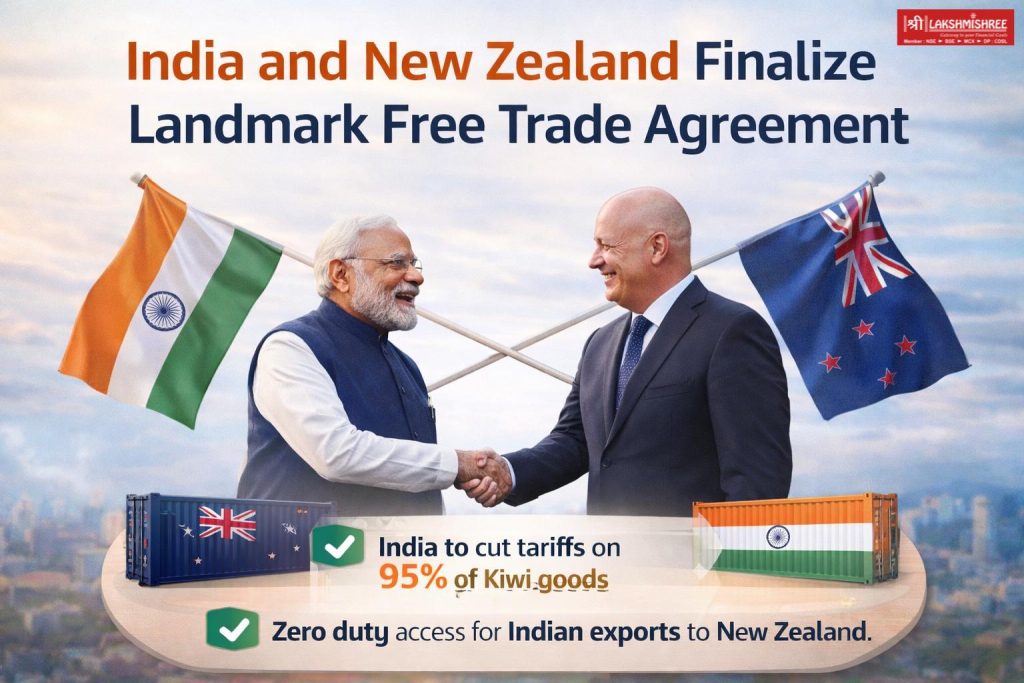
India and New Zealand have successfully concluded a Free Trade Agreement (FTA), an achievement notable for being one of India’s quickest trade deals with a developed economy. This agreement is set to significantly enhance bilateral trade, boost investment, and strengthen people-to-people connections between the two nations.
Key Trade Liberalization
The agreement features substantial market access commitments from both sides:
- New Zealand will provide zero-duty market access for all Indian exports.
- India will implement tariff liberalisation covering approximately 95 percent of bilateral trade, which translates to a significant reduction in import duties on New Zealand goods entering the Indian market.
Swift Negotiation Process
The India-New Zealand FTA negotiations, which began in March 2025, were concluded rapidly after just five rounds of talks, conducted through a blend of in-person and virtual meetings. The final announcement followed a telephone conversation between Prime Minister Narendra Modi and New Zealand Prime Minister Christopher Luxon, highlighting the high-level strategic commitment to the deal.
Prime Minister Luxon underscored the deal’s value, calling India one of the world’s fastest-growing economies and noting that the FTA would grant New Zealand businesses access to India’s 1.4 billion consumers, fostering deeper economic integration.
Broad Sectoral Coverage and Mobility
The trade pact encompasses a wide array of areas, including trade in goods and services, investment, customs procedures, regulatory cooperation, and professional mobility.
In the services sector, New Zealand has opened market access in key areas such as information technology, professional services, tourism, financial services, and education. A major component is the mobility provisions for Indian students and professionals, which cover temporary employment visas and post-study work opportunities.
Investment and Agricultural Focus
New Zealand has committed to facilitating investments totaling $20 billion in India over the next 15 years, underscoring the long-term investment horizon of the agreement.
Cooperation frameworks have also been established in agriculture, including partnerships to improve productivity and planned centres of excellence for apples, kiwifruit, and honey. However, certain sensitive domestic sectors were strategically excluded from the tariff commitments.
Commerce Minister Piyush Goyal characterised the FTA as a people-centric agreement, designed to generate opportunities for farmers, entrepreneurs, students, and professionals. Commerce Secretary Rajesh Agrawal referred to it as a new-generation trade pact, whose scope extends beyond tariffs to include investment, productivity, and talent mobility.
Strategic Importance
Beyond economic ties, the leaders agreed to expand cooperation in defence, education, tourism, and people-to-people exchanges, and pledged close engagement during the implementation phase. The India–New Zealand FTA is a key addition to India’s expanding network of modern trade agreements, aligning with New Delhi’s strategy of deeper integration into global value chains while protecting critical domestic sectors.

Kaashika is a social media strategist and financial content creator at Lakshmishree. She specialises in simplifying complex IPO and stock market concepts into clear, easy-to-understand content. Having created over 500+ pieces of financial content across reels, blogs, website posts and digital creatives, Kaashika helps audiences connect with the world of finance in a more accessible and engaging way.