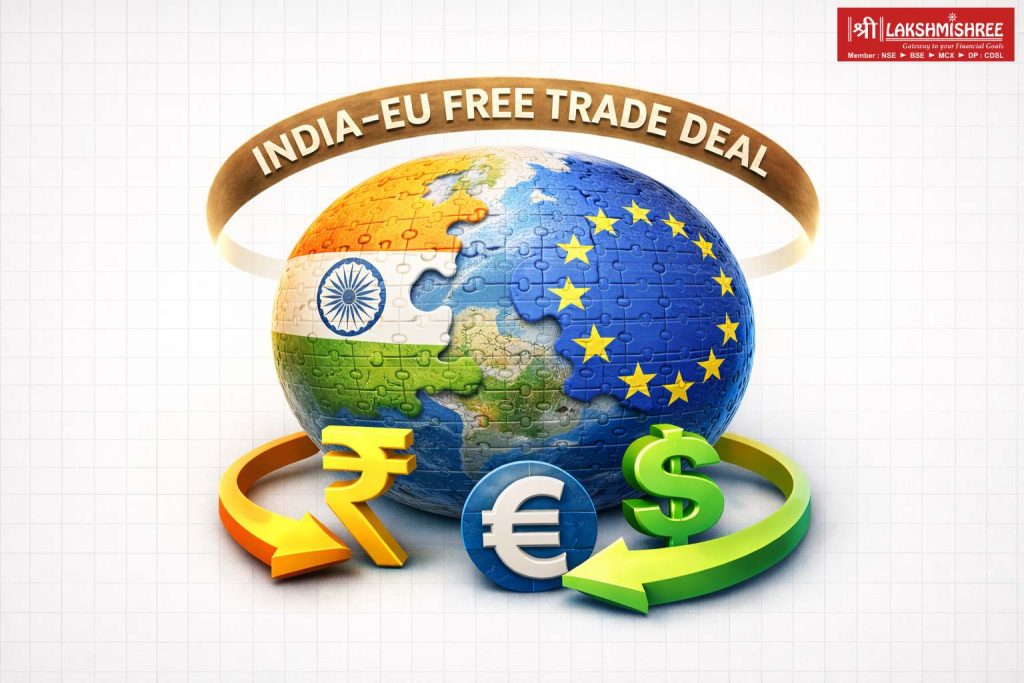
India is approaching a critical juncture in its trade diplomacy as preparations intensify for the upcoming India–European Union summit to be held alongside the 77th Republic Day celebrations. At the centre of the discussions is the long-pending India–EU Free Trade Agreement, formally known as the Broad-based Trade and Investment Agreement (BTIA), which now carries implications far beyond conventional trade liberalisation.
The India–EU Free Trade Agreement is not merely another bilateral pact. If concluded, it would represent one of the most complex, comprehensive, and strategically consequential trade agreements India has negotiated to date, shaping economic relations between two of the world’s largest democratic economies for decades.
Negotiations on the India–EU Free Trade Agreement began in 2007, reflecting early recognition of economic complementarity. India offers scale, demographics, services expertise, and expanding manufacturing capacity, while the European Union brings advanced technology, capital, high-value manufacturing, and access to a large, affluent consumer market. Despite this synergy, talks remained stalled for years due to deep disagreements over market access, regulatory standards, and the preservation of domestic policy autonomy.
Between 2007 and 2013, repeated negotiation rounds exposed persistent fault lines. India resisted steep tariff reductions in sensitive sectors such as automobiles, alcoholic beverages, and agriculture, citing employment concerns, domestic industry protection, and fiscal risks for states. The EU, meanwhile, pushed for stronger commitments on intellectual property rights, data governance, labour norms, environmental standards, and public procurement. These unresolved differences ultimately led to a prolonged pause in negotiations.
The revival of the India–EU Free Trade Agreement in 2022 marked a decisive shift in perspective. In a post-pandemic global economy defined by fractured supply chains, rising geopolitical risk, and strategic trade realignments, trade policy increasingly became an instrument of economic security rather than a purely commercial exercise.
The Core Economic Bargain at the Heart of the India–EU Free Trade Agreement
The renewed urgency around the India–EU Free Trade Agreement is closely linked to global trade disruptions. Elevated tariffs imposed by the United States on select imports have unsettled traditional trade routes, affecting Indian exporters in sectors such as steel, engineering goods, chemicals, and textiles. In this context, the European Union — already India’s largest trading partner — has emerged as a critical diversification market. The EU currently accounts for around 17 per cent of India’s exports, underscoring its central role in India’s external trade strategy.
From the European perspective, the India–EU Free Trade Agreement aligns with a broader recalibration of economic partnerships. As Europe seeks to reduce overdependence on China and strengthen supply-chain resilience, India stands out as one of the few economies offering scale, political stability, and expanding manufacturing depth. Recent EU trade initiatives with Mexico and Indonesia reflect this strategy, with India positioned as a core pillar.
At the heart of the agreement lies a finely balanced economic negotiation. The EU is seeking substantial reductions in India’s high import tariffs on passenger vehicles, auto components, medical devices, wines, spirits, and select processed foods. These demands reflect European competitive strengths but intersect with politically sensitive sectors in India, particularly those tied to employment, small manufacturers, and domestic value chains.
India’s approach to the India–EU Free Trade Agreement has therefore been calibrated rather than confrontational. New Delhi has signalled a preference for phased liberalisation instead of abrupt tariff dismantling. In return, India is pressing for improved access to the EU market in areas of comparative advantage, including pharmaceuticals, textiles and garments, engineering goods, chemicals, and critically services.
Services form a cornerstone of India’s negotiating position. Market access for Indian IT and professional services firms, regulatory clarity on data flows, and improved mobility for skilled professionals remain key priorities. Equally important is predictability around sustainability-linked trade measures, particularly as the EU advances carbon border adjustment mechanisms that could significantly affect Indian exporters.
What the India–EU Free Trade Agreement Means for India’s Global Positioning
Beyond tariffs, the long-term significance of the India–EU Free Trade Agreement lies in its regulatory architecture. Provisions on digital trade, data governance, sustainability standards, and investment protection will shape how Indian and European firms operate across borders for decades. For India, the challenge is securing market access while preserving policy flexibility in areas such as public health, digital sovereignty, and industrial development. For the EU, the test lies in balancing regulatory ambition with pragmatism toward a developing economy partner.
If concluded, the India–EU Free Trade Agreement would mark a decisive shift in India’s trade posture. Since 2014, India has moved from a largely defensive stance to a more selective and strategic engagement with global trade, concluding agreements with partners such as Australia, the UAE, the UK, and EFTA nations. An agreement with the EU would deepen this transformation, embedding India more firmly into global value chains and reinforcing long-term economic alignment with Europe.
The geopolitical implications are equally significant. At a time when the multilateral trading system faces mounting strain, a comprehensive India–EU agreement would reaffirm the relevance of rule-based trade among major economies. It would also strengthen India’s standing as a reliable economic partner as global firms reassess investment destinations amid rising geopolitical uncertainty.
Critical issues, however, remain unresolved. Automobiles, sustainability-linked trade measures, regulatory alignment, and transition timelines continue to require careful negotiation. Even if a broad framework is announced during the upcoming summit, implementation is likely to be gradual, with safeguards and adjustment periods built in.
What distinguishes this moment is its scale and consequence. The India–EU Free Trade Agreement is not simply about tariff reductions or trade volumes. It is about defining India’s role in a rapidly evolving global economic order. Whether years of negotiation translate into a landmark economic agreement will become clear in the coming weeks, but the strategic stakes have rarely been higher.

Kaashika is a social media strategist and financial content creator at Lakshmishree. She specialises in simplifying complex IPO and stock market concepts into clear, easy-to-understand content. Having created over 500+ pieces of financial content across reels, blogs, website posts and digital creatives, Kaashika helps audiences connect with the world of finance in a more accessible and engaging way.