
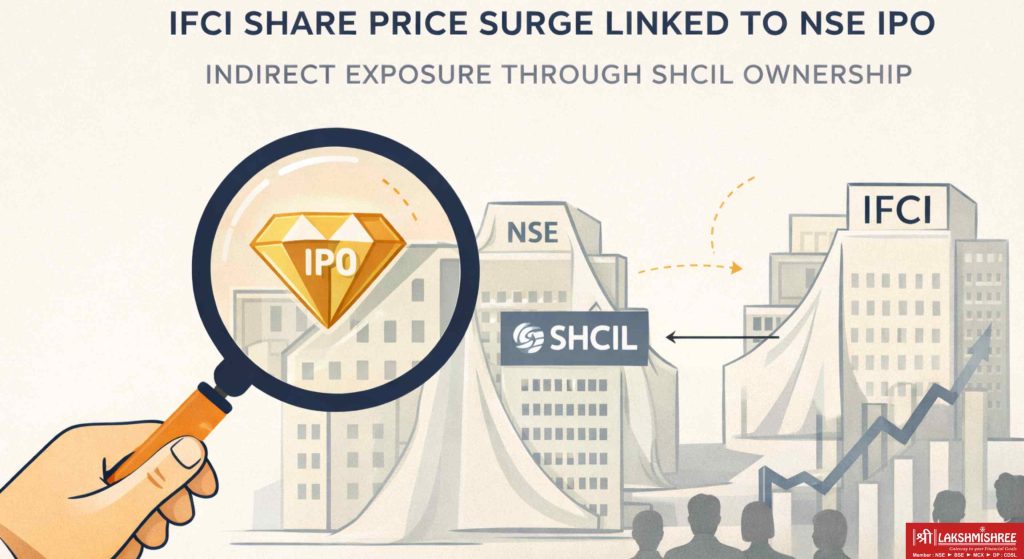
IFCI shares price recorded a sharp rise of approximately 25–26% within a week, significantly outperforming both the broader equity market and the small-cap index. The move of IFCI Ltd. was accompanied by a notable increase in trading volumes, indicating fresh investor participation rather than technical short covering. The price action was not triggered by an improvement in IFCI’s operating performance or lending activity, but by renewed market focus on its indirect exposure to the National Stock Exchange (NSE) ahead of a potential initial public offering (IPO).
The NSE IPO has been under consideration for several years, with regulatory approvals acting as the primary constraint. Recent developments and market signals have strengthened expectations that the approval process may be approaching a critical stage. Given NSE’s status as India’s dominant equity exchange and one of the most valuable market infrastructure institutions in the country, its eventual listing is expected to result in formal price discovery and valuation benchmarking. Such an event has implications not only for direct shareholders but also for entities with indirect economic interests in NSE.
IFCI’s Indirect Exposure and the IPO Proxy Mechanism
IFCI does not hold shares in NSE directly. Its relevance to the NSE IPO narrative arises from its ownership stake in Stock Holding Corporation of India (SHCIL). SHCIL, in turn, holds an estimated 4.4% stake in NSE. This creates an indirect valuation linkage whereby changes in NSE’s perceived or realised valuation influence the implied value of IFCI’s investment holdings.
This structure has led market participants to categorise IFCI as an “IPO proxy play.” In equity markets, IPO proxy plays emerge when investors seek exposure to an anticipated listing through listed intermediaries, particularly when unlisted shares are illiquid or inaccessible. Such strategies are commonly observed ahead of large public listings, asset monetisation exercises, or holding company re-ratings. In IFCI’s case, the expectation is that a publicly listed NSE would enable clearer valuation of SHCIL’s stake, which would then be reflected in IFCI’s net asset value.
The speed of the price adjustment can be attributed to IFCI’s small-cap classification, relatively limited free float, and the asset-based nature of its balance sheet. These characteristics tend to amplify price movements when a new valuation narrative gains traction.
NSE IPO → Higher NSE valuation → Higher value of SHCIL’s stake → Higher implied value of IFCI’s holding
Implications, Risks, and Investor Relevance
The recent price appreciation in IFCI shares is not supported by a corresponding improvement in earnings, asset quality, or return metrics. The rally is event-driven and linked to external valuation expectations rather than core business fundamentals. As such, the stock’s performance is sensitive to developments related to the NSE IPO timeline and regulatory outcomes.
Should regulatory approval for the NSE IPO materialise, the resulting price discovery could prompt a reassessment of SHCIL’s stake and, by extension, IFCI’s investment portfolio. This may lead to a re-evaluation of IFCI’s net asset value by the market. Conversely, further delays or uncertainty surrounding the IPO process could result in the withdrawal of speculative premium embedded in the stock following the recent rally.
The current price movement is therefore most relevant to event-driven investors, traders focused on valuation re-rating opportunities, and asset-value-oriented investors already analysing IFCI from a holding company perspective. It is less relevant for investors assessing IFCI purely on the basis of operating performance or near-term earnings growth.
In summary, IFCI’s share price surge reflects market positioning around a potential capital markets event rather than a fundamental shift in the company’s underlying business. The sustainability of this re-rating will depend on the progression of the NSE IPO and the market’s subsequent reassessment of linked asset values.

Kaashika is a social media strategist and financial content creator at Lakshmishree. She specialises in simplifying complex IPO and stock market concepts into clear, easy-to-understand content. Having created over 500+ pieces of financial content across reels, blogs, website posts and digital creatives, Kaashika helps audiences connect with the world of finance in a more accessible and engaging way.