
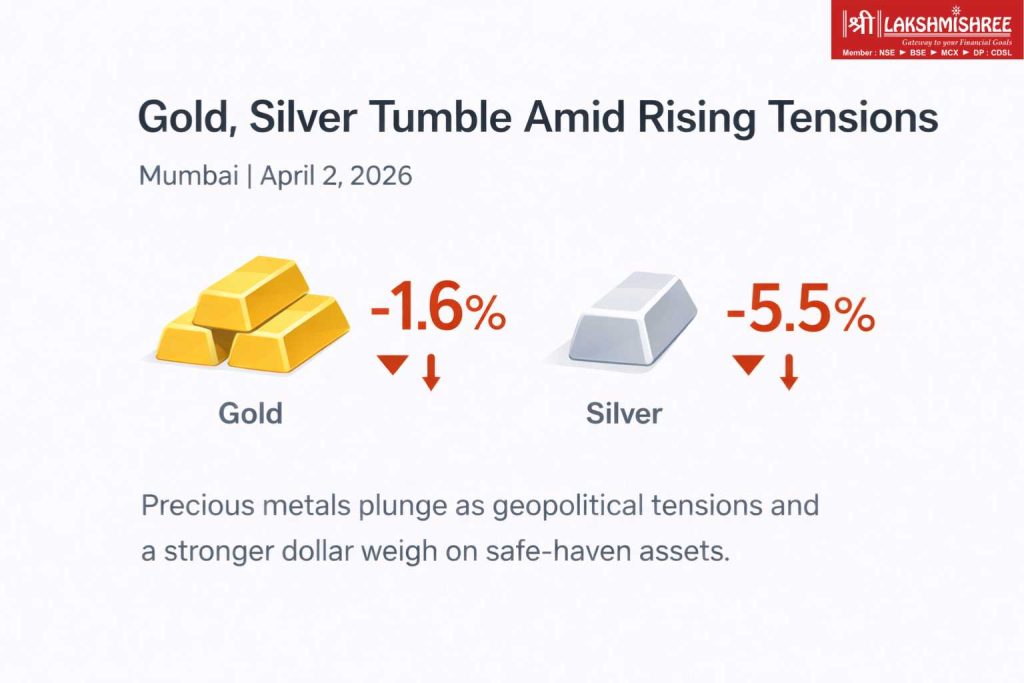
Precious metals came under sharp selling pressure on Thursday, with silver plunging over 5.5% and gold falling more than 1% on the Multi Commodity Exchange (MCX), as escalating geopolitical tensions and a stronger dollar weighed on investor sentiment, April 2, 2026.
The decline followed fresh remarks from U.S. President Donald Trump, who signaled continued military action against Iran, dampening hopes of a near-term de-escalation. The hawkish tone triggered volatility across global markets, reducing the appeal of traditional safe-haven assets like gold and silver.
Silver witnessed the steepest fall, dropping 5.5% in domestic trade, while gold declined around 1.6%, tracking weakness in international bullion markets. Analysts attributed the sharp correction to rising U.S. bond yields, a strengthening dollar and elevated crude oil prices, all of which typically act as headwinds for precious metals.
The broader trend in bullion has remained weak. Gold prices have fallen more than 11% in March, marking their sharpest monthly decline since October 2008. The downturn reflects a shift in market expectations, with investors now largely ruling out any U.S. Federal Reserve rate cuts this year, compared to earlier expectations of multiple reductions.
A stronger dollar has further reduced the attractiveness of gold, making it more expensive for holders of other currencies. At the same time, higher interest rates increase the opportunity cost of holding non-yielding assets such as bullion.
In the domestic market, gold prices in Mumbai stood at around ₹1,12,168 per 8 grams for 22-carat and ₹1,22,368 per 8 grams for 24-carat gold, reflecting the broader downward trend.
Despite the current weakness, analysts believe volatility in precious metals is likely to persist in the near term, driven by geopolitical developments and macroeconomic factors. Some experts expect a phase of consolidation before any meaningful upward movement, with global gold prices potentially moving towards higher resistance levels once stability returns.
Market participants have been advised to remain cautious, avoid aggressive fresh positions at elevated levels and consider booking profits during intermittent rallies, as uncertainty continues to dominate global financial markets.
The sharp fall highlights a shift in investor behavior, where even traditional safe-haven assets are reacting more to interest rate expectations and currency movements than geopolitical tensions alone.

Kaashika is a social media strategist and financial content creator at Lakshmishree. She specialises in simplifying complex IPO and stock market concepts into clear, easy-to-understand content. Having created over 500+ pieces of financial content across reels, blogs, website posts and digital creatives, Kaashika helps audiences connect with the world of finance in a more accessible and engaging way.