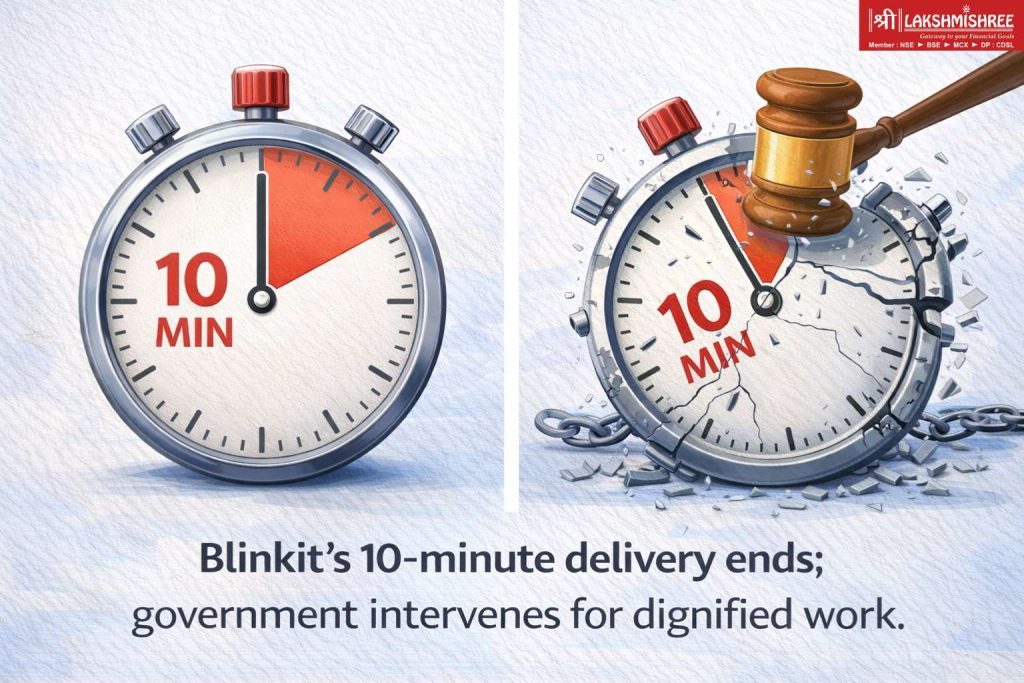
India’s quick-commerce boom has hit a regulatory pause. Blinkit’s 10-minute delivery promise—once the defining symbol of ultra-fast convenience—has now been rolled back following intervention by the Union Ministry of Labour. The move marks a turning point not just for Blinkit, but for the entire quick-commerce ecosystem that includes Zepto, Swiggy Instamart and Zomato.
The decision reflects growing concerns over gig worker safety, labour protections, and the sustainability of hyper-compressed delivery timelines, even as India’s app-based delivery economy continues to expand rapidly.
From “10 Minutes” to “At Your Doorstep”
Blinkit has officially removed the “10-minute delivery” claim from its branding, advertisements, and digital platforms. The company’s primary tagline has been revised from:
“10,000+ products delivered in 10 minutes”
to
“30,000+ products delivered at your doorstep.”
This shift followed discussions between Union Labour Minister Mansukh Mandaviya and senior officials from Blinkit, Zepto, Swiggy and Zomato. According to ministry sources, companies were urged to eliminate rigid delivery-time commitments that could pressure delivery partners into unsafe behaviour.
While the government has not imposed a formal ban on fast deliveries, the message was clear: speed should not come at the cost of worker safety.
Why the Government Intervened
The trigger for the Centre’s action was mounting evidence that aggressive delivery promises were translating into on-ground risks for gig workers.
Key concerns raised during consultations included:
- Riders speeding or violating traffic rules to meet time targets
- Increased road accidents linked to time pressure
- Mental stress caused by performance-based penalties
- Lack of control riders have over traffic, weather and order density
These concerns were amplified after a nationwide gig-worker strike on December 31, 2025, when delivery partners protested low pay, unsafe working conditions and unrealistic timelines.
Labour Ministry officials concluded that branding built around extreme delivery speeds indirectly incentivised risk-taking, even if companies did not explicitly mandate unsafe practices.
Blinkit’s 10-Minute Delivery: A Symbol of the Q-Commerce Race
Blinkit’s 10-minute delivery model was never just about logistics—it was a marketing weapon. Along with Zepto’s similar claims, it reshaped consumer expectations and intensified competition in urban markets.
The model relied on:
- Dense networks of dark stores
- Predictive inventory placement
- Algorithmic rider dispatch
- Hyper-local demand forecasting
While operationally impressive, critics argued that the last mile of the system—the rider—absorbed most of the pressure, especially during peak hours.
The Centre’s intervention signals that India’s regulatory framework is catching up with platform-driven business models.
What Happens to Zepto, Swiggy and Zomato?
Although Blinkit acted first, officials indicated that other quick-commerce platforms are expected to follow.
- Swiggy Instamart and Zepto have been advised to reassess delivery-time messaging
- Zomato, which owns Blinkit, was part of the Labour Ministry discussions
- Companies may continue fast deliveries operationally, but without rigid public promises
This suggests a shift from time-guarantees to service-quality narratives, focusing on selection, reliability and experience rather than raw speed.
The Larger Context: Gig Economy Regulation Gains Momentum
The rollback of Blinkit’s 10-minute delivery promise fits into a broader policy trend: formalising protections for gig and platform workers.
Recent developments include:
- Rajasthan (2023) becoming the first state to enact a gig-workers law
- Karnataka and Jharkhand passing similar legislation
- Telangana examining a framework for platform worker welfare
- Draft Social Security Code provisions at the Centre level
These initiatives aim to create:
- Welfare boards for gig workers
- Social security funds financed by platform contributions
- Grievance redressal mechanisms
- Accident and health insurance coverage
The Centre’s engagement with quick-commerce companies shows a preference for course correction through dialogue rather than outright prohibition.
Business Impact: Will Quick Commerce Slow Down?
Despite the headlines, analysts do not expect a collapse in the quick-commerce model.
Key reasons:
- Demand for convenience remains strong in urban India
- Platforms can still deliver quickly without advertising strict timelines
- Operational efficiencies, not slogans, drive customer retention
Swiggy’s valuation of around $11 billion and Zomato’s market capitalisation near $28 billion underscore the sector’s scale. The change is more about responsible growth than retrenchment.
In fact, removing rigid timelines could:
- Reduce rider attrition
- Improve platform reputation
- Lower accident-related costs
- Strengthen long-term sustainability
A Shift in Narrative: From Speed to Safety
The end of Blinkit’s 10-minute delivery promise reflects a maturing digital economy. India’s policymakers appear increasingly willing to step in when innovation creates unintended social costs.
For consumers, deliveries may still feel fast.
For platforms, competition will continue.
But for delivery partners, the signal is important: safety now has institutional backing.
Conclusion
Blinkit’s 10-minute delivery may have defined an era of Indian quick commerce, but its rollback marks a necessary recalibration. The Centre’s intervention highlights the growing recognition that platform efficiency must be balanced with human welfare.
As India’s gig economy evolves, the focus is shifting—from speed at any cost to sustainable, dignified work. This episode is likely to serve as a template for how future conflicts between innovation and labour rights are resolved.

Kaashika is a social media strategist and financial content creator at Lakshmishree. She specialises in simplifying complex IPO and stock market concepts into clear, easy-to-understand content. Having created over 500+ pieces of financial content across reels, blogs, website posts and digital creatives, Kaashika helps audiences connect with the world of finance in a more accessible and engaging way.