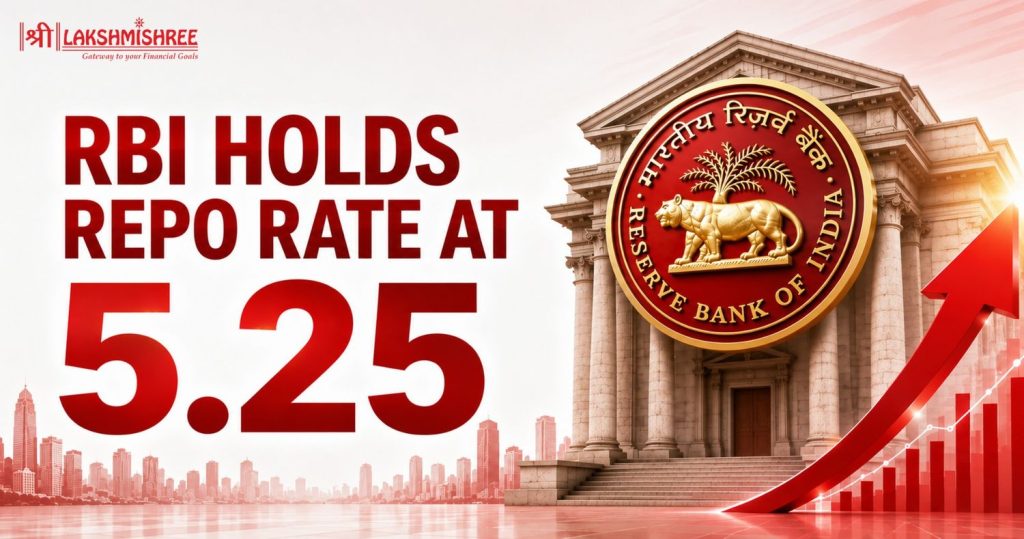
The Reserve Bank of India (RBI) Monetary Policy Committee (MPC) has unanimously decided to keep the benchmark repo rate unchanged at 5.25%. By maintaining a “neutral” policy stance, the central bank is signalling a priority on economic stability as it navigates a landscape defined by volatile global energy prices, the West Asia conflict, and persistent food inflation risks. The decision was widely anticipated, but the underlying message emphasizes a “wait-and-watch” approach to ensure inflation aligns with targets while supporting resilient domestic growth.
Why the RBI Chose Repo Rate at 5.25%
The central bank finds itself balancing a resilient domestic economy against a “hazy” global outlook. While India’s internal activity remains strong, reflected in the upwardly revised Real GDP growth projection of 6.7%, the external environment remains hostage to the scale and intensity of the conflict in West Asia.
Governor Sanjay Malhotra noted that while banking and NBFC parameters relating to capital adequacy and asset quality remain healthy, the RBI requires greater clarity on the inflation trajectory before taking further policy action. Consequently, the Standing Deposit Facility (SDF) remains at 5%, and the Marginal Standing Facility (MSF) and bank rate stay at 5.5%.
As the RBI continues to prioritize financial stability, the strength of India’s banking ecosystem remains a key pillar of economic resilience. From public sector giants to leading private banks, each institution plays a vital role in transmitting monetary policy and supporting growth. For a detailed comparison of the country’s top lenders, read our guide to the best banks in India.
The Real Concern: Inflation Risks and Global Shocks
The biggest challenge facing the MPC is the potential for supply-side pressures to trigger a comeback in headline inflation. While core inflation, excluding food and fuel, remained steady at 3.9% in May and June, headline inflation is expected to rise in the near term and peak in Q3 of FY27.
Several factors cloud the inflation outlook:
- Volatile Energy Prices: Sharp two-way movements in global oil prices are being triggered by geopolitical developments.
- Climate Risks: The impact of El Niño on the temporal and spatial distribution of monsoon rainfall remains a significant risk to food prices.
- Imported Inflation: Potential re-escalation of conflicts and supply chain disruptions continue to pose upside risks to costs.
Currently, the CPI inflation projection for the year stands at 5%, which is 10 basis points lower than previous projections.
External Resilience and the Rupee
A major theme of this policy is the resilience of India’s economy despite a challenging macroeconomic environment. India’s current account recorded a surplus of $2.8 billion during April-May this year, driven by services trade and strong remittances. However, the merchandise trade deficit widened to $86 billion in Q1, primarily due to imports of crude oil, gold, and electronics.
The Indian rupee has faced pressure, recently opening below the 95/$ mark for the first time since July. To manage this, the RBI is relying on a toolkit that includes attracting foreign capital inflows; notably, FCNR(B) deposits crossed $60 billion by the end of July, and maintaining robust foreign exchange interventions to curb excessive volatility.
What This Means for Markets and Borrowers
For borrowers, the pause suggests that loan rates and EMIs are unlikely to see an immediate hike, providing predictability for financing costs in sectors like real estate. For investors, the policy provided a boost to sentiment, with the Sensex surging over 300 points following the announcement and the Nifty testing the 24,600 level.
Markets are responding to the RBI’s commitment to macroeconomic stability, even as the central bank warns that a rate hike later in the year cannot be entirely ruled out if inflationary pressures become persistent.
The Bigger Story
The RBI’s decision highlights a broader shift toward defensive positioning in an era of global volatility. The challenge is no longer just about boosting growth, which remains robust due to strong domestic demand and government infrastructure spending. Instead, policymakers are effectively “buying time” to see if inflation pressures, particularly from food and fuel, prove temporary or evolve into a more persistent threat.
By holding the rate at 5.25%, the RBI reinforces a message of caution and consistency, ensuring that India remains an attractive destination for long-term capital while keeping a close eye on the shifting sands of global geopolitics.

Kaashika is a social media strategist and financial content creator at Lakshmishree. She specialises in simplifying complex IPO and stock market concepts into clear, easy-to-understand content. Having created over 500+ pieces of financial content across reels, blogs, website posts and digital creatives, Kaashika helps audiences connect with the world of finance in a more accessible and engaging way.