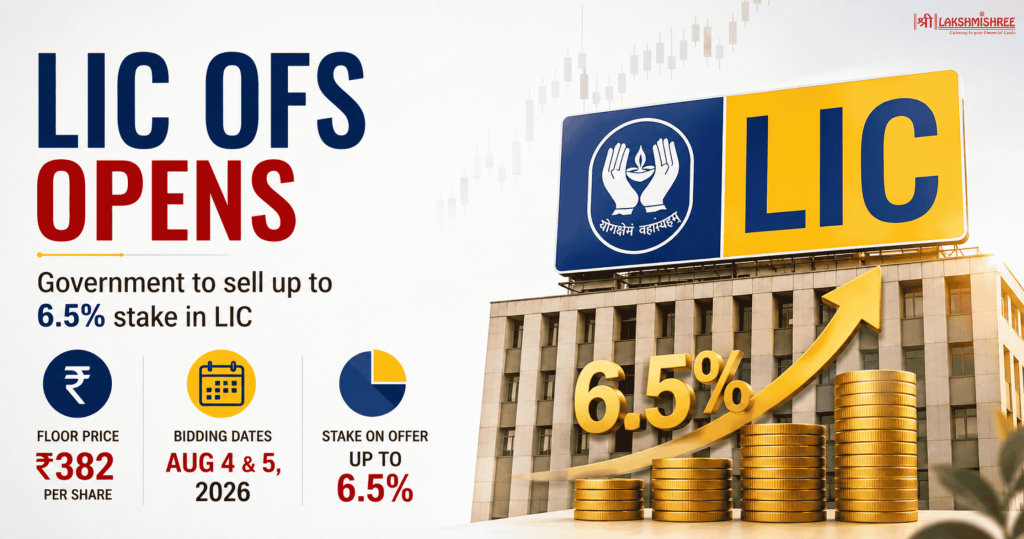
The Government of India has launched an Offer for Sale (OFS) to sell up to a 6.50% stake in Life Insurance Corporation of India (LIC). The offer opens for non-retail investors on August 4, 2026, while retail investors and eligible employees can participate on August 5, 2026.
The floor price for the OFS has been fixed at ₹382 per share, a discount of around 10% to 11% to LIC’s closing market price on August 3, 2026. The stock closed at ₹424.35 on the BSE and ₹428.50 on the NSE.
If the entire 6.50% stake is sold, the government could raise nearly ₹31,000 crore through the transaction. The stake sale would also reduce the government’s holding in LIC from 96.5% to 90%.
LIC OFS at a Glance
| Particulars | Details |
|---|---|
| Total Stake on Offer | Up to 6.50% |
| Base Offer | 2.50% |
| Green Shoe Option | Additional 4.00% |
| Floor Price | ₹382 per share |
| Non-Retail Bidding | August 4, 2026 |
| Retail & Employee Bidding | August 5, 2026 |
| Bidding Time | 9:15 a.m. to 3:30 p.m. IST |
| Retail Reservation | Minimum 10% |
| Retail Discount | ₹10 per share |
| Employee Reservation | 50 lakh shares |
| Employee Discount | ₹10 per share |
Government to Sell Up to 6.5% Stake in LIC
The OFS consists of a base offer of 31,62,49,885 equity shares, representing 2.50% of LIC’s total paid-up equity capital.
The government also has an oversubscription, or green shoe, option to sell another 50,59,99,816 equity shares, representing an additional 4.00% stake.
If the green shoe option is fully exercised, the total stake sold through the OFS would reach 6.50%, equivalent to more than 82.22 crore shares.
The transaction is being managed by IIFL Capital Services, BNP Paribas Securities India, Goldman Sachs (India) Securities and Motilal Oswal Investment Advisors.
Floor Price and Bidding Schedule
The government has fixed the floor price at ₹382 per LIC share. This represents a discount of around 10% to 11% compared with LIC’s closing prices of ₹424.35 on the BSE and ₹428.50 on the NSE on August 3.
The OFS is being conducted over two trading days.
Non-retail investors can place their bids on August 4 between 9:15 a.m. and 3:30 p.m. IST. They can also choose to carry forward their unallotted bids and revise them on the following day.
Retail investors and eligible LIC employees can participate on August 5 during the same bidding hours.
LIC has also announced that its internal trading window will remain closed for designated persons until August 8, 2026.
What Does the OFS Offer to Retail Investors and Employees?
A minimum of 10% of the offer shares has been reserved for retail investors.
Individual investors placing total bids of not more than ₹2 lakh across exchanges will be classified as retail investors. They will be eligible for a discount of ₹10 per share on the determined cut-off price.
LIC employees have a separate reservation of 50 lakh equity shares, representing 0.04% of the company’s total paid-up equity capital.
Eligible employees can apply for shares worth up to ₹5 lakh. However, the standard individual allotment is capped at ₹2 lakh. If the employee portion remains under-subscribed, additional allotment can be made up to the ₹5 lakh limit.
Employees will also receive a ₹10 per share discount on the cut-off price.
For non-retail investors, 100% of the bid value has to be deposited upfront. At least 25% of the offer shares are reserved for SEBI-registered Mutual Funds and IRDAI-registered Insurance Companies.
Apart from Mutual Funds and Insurance Companies, no single bidder can be allocated more than 25% of the offer shares.
Why is the Government Selling More LIC Shares?
The LIC stake sale is important in the context of minimum public shareholding requirements.
Under SEBI rules, listed companies are required to maintain a minimum public shareholding of 25%. Given LIC’s size, the insurer has been provided an extended timeline to meet the requirement.
The government currently holds 96.5% of LIC and is required to bring its stake down to 90%, resulting in at least 10% public shareholding, by May 16, 2027.
If the entire 6.50% stake offered in the current OFS is sold, the government’s holding will fall from 96.5% to exactly 90%. LIC would therefore meet its May 2027 public shareholding requirement ahead of schedule.
The insurer will subsequently have to achieve the standard 25% minimum public shareholding by 2032.
| Stage | Government Holding | Public Shareholding |
|---|---|---|
| Before Current OFS | 96.5% | 3.5% |
| After Full 6.50% OFS | 90% | 10% |
| Final MPS Requirement | 75% | 25% |
How Much Could the Government Raise Through the LIC OFS?
At the floor price of ₹382 per share, the base 2.50% stake sale could fetch approximately ₹12,080 crore.
If the additional 4% green shoe option is fully exercised, taking the total stake sale to 6.50%, the government is expected to raise nearly ₹31,000 crore.
The transaction forms a significant part of the government’s capital receipts for FY27.
The central government has budgeted ₹80,000 crore under “miscellaneous capital receipts”, which includes proceeds from disinvestment and asset monetization.
Before the LIC OFS, the government had raised ₹21,201 crore through stake sales in seven public sector undertakings, including Central Bank of India, Coal India, NHPC and GIC, along with remittances from SUUTI.
A fully subscribed LIC OFS would take total receipts past ₹50,000 crore, helping the government achieve more than 60% of its annual target.
From the Interim Budget for FY25 onward, the government stopped setting a separate standalone disinvestment target and merged such proceeds into miscellaneous capital receipts. This followed repeated misses of previous disinvestment targets, with the government meeting its target only three times in the preceding decade.
LIC IPO vs Current OFS
LIC was listed on the stock exchanges in May 2022 through India’s largest-ever IPO. At the time, the government sold a 3.5% stake in the insurer at a price band of ₹902–949 per share, raising approximately ₹21,000 crore.
The current transaction differs from the 2022 IPO as it is an Offer for Sale of the government’s existing stake.
| Particulars | LIC IPO – May 2022 | LIC OFS – August 2026 |
|---|---|---|
| Transaction | IPO | Offer for Sale |
| Government Stake Offered | 3.5% | Up to 6.50% |
| Price | ₹902–949 price band | ₹382 floor price |
| Amount | About ₹21,000 crore | Up to nearly ₹31,000 crore |
What’s Next for LIC?
The OFS will be followed closely by LIC’s Q1 FY27 financial results.
The company’s Board of Directors is scheduled to meet on August 6, 2026, a day after the OFS closes, to approve its unaudited standalone and consolidated financial results for the quarter. An earnings call is scheduled for 7:00 p.m. IST on the same day.
LIC currently has a market capitalization of more than ₹5.36 lakh crore.
The insurer has also recently seen changes in its senior management. On July 28, Varadarajan was appointed Chief Risk Officer (CRO), while Shrivastava was appointed Chief Financial Officer (CFO). Independent Directors Mahalingam G and Parthasarathy also stepped down.
On July 30, LIC received a GST demand order from CGST authorities in Jamshedpur totaling ₹10.9 crore, including ₹99.09 crore in GST and a ₹9.90 crore penalty, over alleged premature Input Tax Credit claims. LIC stated that the order has no material impact on its overall finances or operations.
Conclusion
The LIC OFS marks a significant stake sale by the Government of India, with up to 6.50% of the insurer’s equity being offered at a floor price of ₹382 per share.
Apart from potentially raising nearly ₹31,000 crore, a fully subscribed offer would reduce the government’s holding from 96.5% to 90%. This would take LIC’s public shareholding to 10% and help the insurer meet its May 2027 minimum public shareholding requirement ahead of schedule.

Kaashika is a social media strategist and financial content creator at Lakshmishree. She specialises in simplifying complex IPO and stock market concepts into clear, easy-to-understand content. Having created over 500+ pieces of financial content across reels, blogs, website posts and digital creatives, Kaashika helps audiences connect with the world of finance in a more accessible and engaging way.