
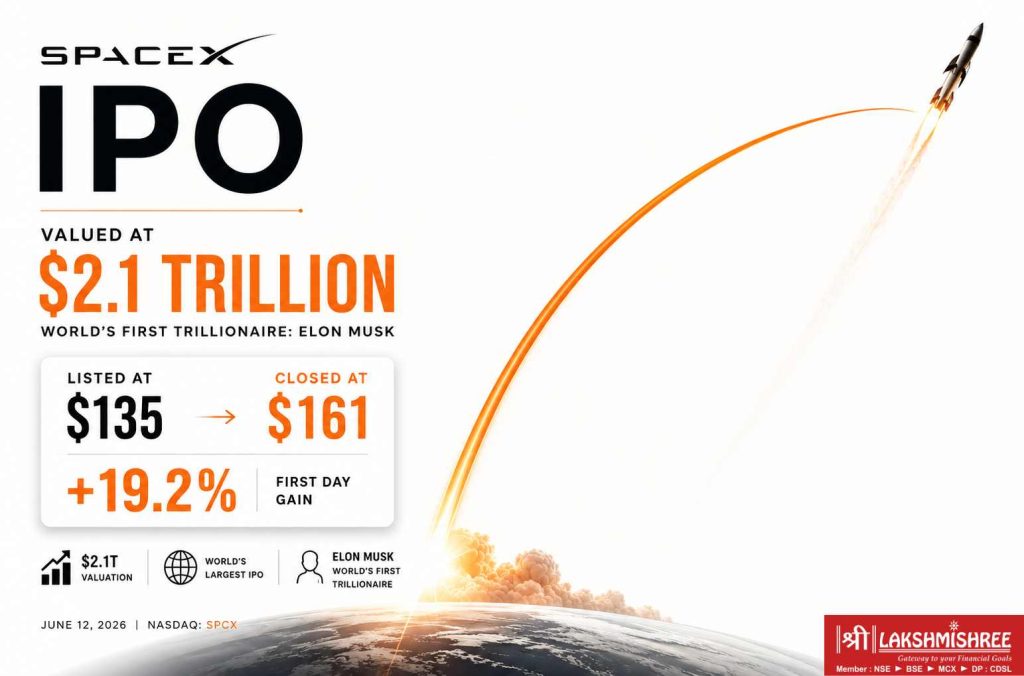
Wall Street has seen internet booms, electric vehicle manias and artificial intelligence frenzies. On Friday, it witnessed something entirely new, I.e The Largest IPO EVER.
A company that has never reported a full-year profit became one of the most valuable businesses on Earth.
SpaceX surged 19% in its Nasdaq debut, closing at $160.95 per share and lifting its valuation to roughly $2.1 trillion. The rally instantly pushed founder Elon Musk’s net worth beyond $1 trillion, making him the first person in history to cross the trillionaire threshold.
SpaceX wants to be able to take you to the moon, take you to Mars and ultimately beyond.
Elon Musk
But the numbers alone do not explain what happened.
The real story is that investors were not buying today’s earnings. They were buying tomorrow’s possibilities.
For years, SpaceX existed as a private company that ordinary investors could only watch from a distance. During that time it transformed the economics of space launches, built the world’s largest satellite internet network through Starlink, entered artificial intelligence through xAI, and repeatedly spoke about an ambition that sounds closer to science fiction than a corporate strategy: putting humans on Mars.
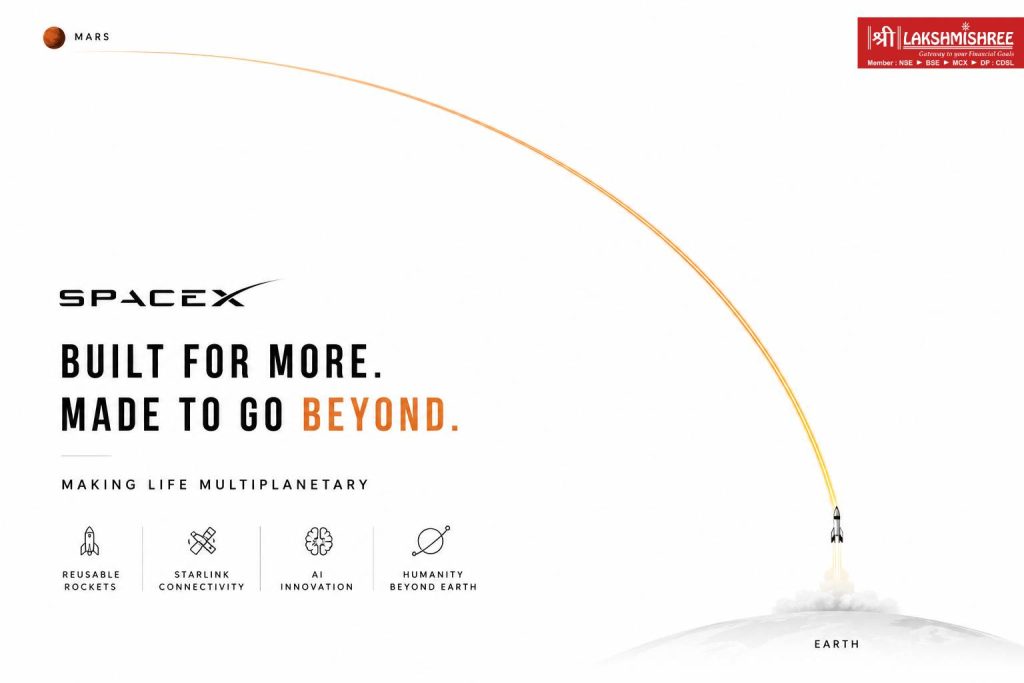
Friday was the first moment public investors were allowed to participate in that vision.
The response was immediate.
More than 510 million shares changed hands during the session, representing approximately $84 billion in trading activity. Retail investors fought for allocations, some celebrating ownership of even a single share. Institutions piled in despite the company’s enormous valuation and continuing losses.
Speaking from Starbase, Texas, Musk used the occasion not to discuss quarterly earnings or profit margins, but to repeat a message that has defined SpaceX for more than two decades.
“SpaceX wants to be able to take you to the moon, take you to Mars and ultimately beyond.”
That sentence may explain the IPO better than any balance sheet.
Traditional valuation models struggle to justify a company worth more than $2 trillion that generated billions of dollars in losses. Critics argue that investors are paying extraordinary prices for uncertain future profits. Supporters counter that every transformational company appears expensive before its impact becomes obvious.
The debate mirrors earlier moments in market history.
Amazon spent years prioritising growth over profits. Tesla was dismissed for much of its early life as a speculative dream. Today, SpaceX has become the latest company asking investors to look beyond present-day financial statements and place a wager on a radically different future.
The enthusiasm was visible across Wall Street.
SpaceX immediately became one of America’s six most valuable publicly traded companies. Its debut dominated trading activity, drew attention away from other technology stocks, and reignited discussions about future public offerings from AI giants such as OpenAI and Anthropic.
Yet beneath the celebration lies a question that investors will continue debating long after the opening-day excitement fades.
Is SpaceX worth $2.1 trillion because of what it is today?
Or because of what people believe it could become?
For now, the market has delivered its answer.
Investors were not valuing a rocket company.
They were valuing a future in which space, satellites, artificial intelligence and human expansion beyond Earth all converge under one corporate roof.
Whether that future eventually justifies the price remains uncertain.
What is certain is that Wall Street has rarely placed a bigger bet on a vision than it did on SpaceX.

News Desk