
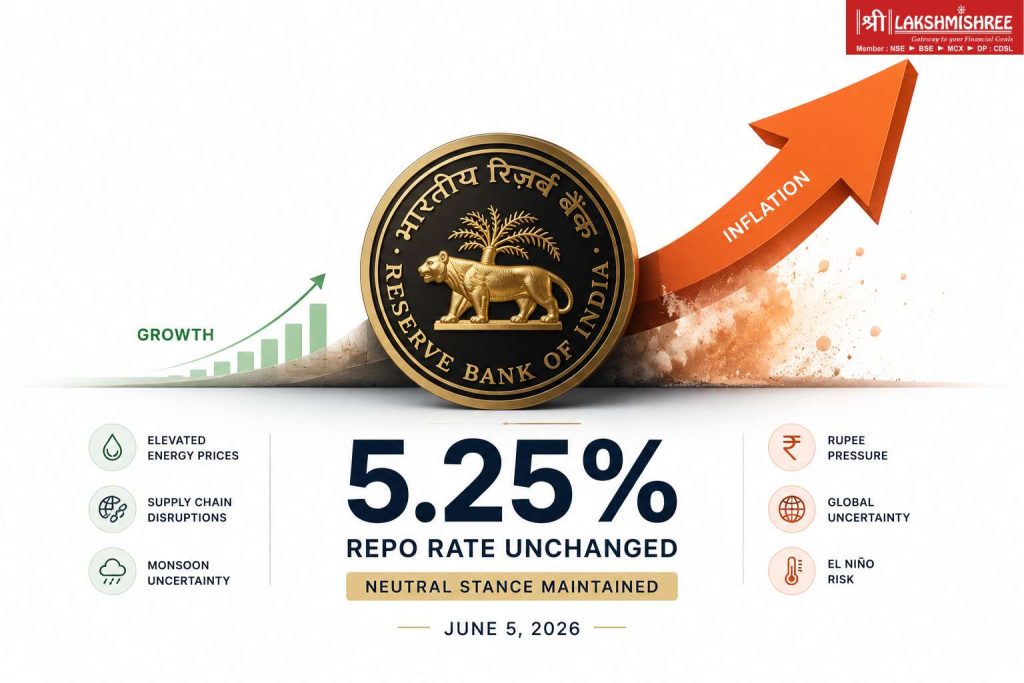
The Reserve Bank of India (RBI) on Friday kept the benchmark (unchanged repo rate) at 5.25% and maintained its “neutral” policy stance, signalling that the central bank is prioritising stability as the economy navigates rising inflation risks, rupee pressure, and global geopolitical uncertainty.
The decision was widely expected by markets, but the message behind it is more important than the rate itself.
At first glance, India’s inflation appears under control. Consumer inflation remains below the RBI’s target level, while economic activity continues to show resilience. However, beneath the surface, policymakers are increasingly concerned about a combination of factors that could make inflation harder to manage in the coming months.
Why the RBI Chose Repo Rate at 5.25%
The central bank finds itself balancing two competing realities.
On one hand, economic growth needs support as higher energy costs and global uncertainty begin affecting business sentiment. On the other, inflation risks are building rapidly.
Governor Sanjay Malhotra pointed to elevated energy prices, supply chain disruptions, monsoon uncertainty, and potential El Niño-related weather risks as key concerns that could push inflation higher later in FY27.
The RBI also acknowledged that the impact of recent global supply shocks may become more visible from the final quarter of the fiscal year onward.
As a result, policymakers appear unwilling to cut rates despite slowing momentum in certain sectors of the economy.
The Real Concern: Inflation Is Returning
The biggest challenge facing the RBI today is not growth—it is the possibility of inflation making a comeback.
Crude oil prices remain elevated due to ongoing tensions in West Asia. Higher fuel costs have already resulted in petrol and diesel price increases across India, which economists estimate could add 30-35 basis points to inflation in the coming months.
Food inflation is another major risk.
A weaker-than-expected monsoon or an El Niño event could impact agricultural production, leading to higher food prices. Since food constitutes a significant portion of India’s inflation basket, even a moderate supply disruption can quickly affect household budgets.
This explains why the RBI continues to maintain a cautious stance despite inflation currently remaining within its target range.
Why the Rupee Matters More Than Ever
Another major theme emerging from the policy discussion is the health of the Indian rupee.
The currency has come under pressure in recent months, touching record lows against the US dollar. A weaker rupee increases the cost of importing essential commodities such as crude oil, fertilisers, electronics, and gold. Those higher import costs eventually flow into inflation.
Rather than defending the currency through aggressive rate hikes, the RBI appears to be relying on a broader toolkit that includes foreign exchange interventions, liquidity management measures, and regulatory actions aimed at reducing speculative pressure on the rupee.
This approach reflects lessons learned from the 2013 currency crisis, when higher interest rates alone proved insufficient to stabilise the rupee.
What This Means for Markets and Borrowers
For borrowers, the immediate takeaway is simple: loan rates are unlikely to rise in the near term.
For investors, however, the policy signals a more complex environment.
A stable repo rate supports equities and economic activity, but persistent inflation risks could limit the RBI’s ability to ease policy later this year. Sectors sensitive to interest rates, such as banking, real estate, and automobiles, will closely watch future inflation data and oil price movements.
Meanwhile, the RBI’s neutral stance suggests that policymakers want flexibility. They are neither committing to rate cuts nor signalling imminent rate hikes.
The Bigger Story
The RBI’s latest decision highlights a broader shift in India’s economic landscape.
The challenge is no longer simply boosting growth. Instead, policymakers must navigate a world where geopolitical conflicts, energy prices, climate-related risks, and currency volatility are increasingly interconnected.
By holding the repo rate at 5.25%, the RBI is effectively buying time—waiting to see whether inflation pressures prove temporary or evolve into a more persistent threat.
For now, the central bank’s message is clear: stability comes first, and caution remains the preferred policy choice in an uncertain global environment.

Kaashika is a social media strategist and financial content creator at Lakshmishree. She specialises in simplifying complex IPO and stock market concepts into clear, easy-to-understand content. Having created over 500+ pieces of financial content across reels, blogs, website posts and digital creatives, Kaashika helps audiences connect with the world of finance in a more accessible and engaging way.