
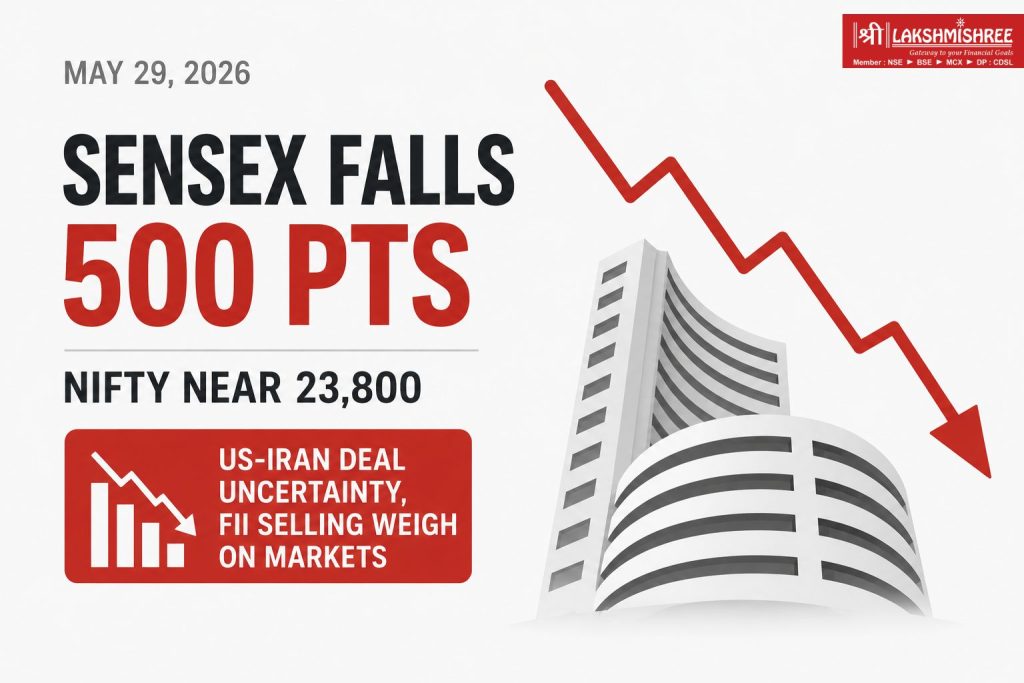
Indian benchmark indices surrendered early gains on May 29, with the Sensex falling nearly 500 points from its intraday high and the Nifty slipping towards the 23,800 mark as investors turned cautious amid uncertainty surrounding a potential US-Iran peace agreement and continued foreign institutional investor (FII) selling.
At around 12:16 PM, the Sensex was trading 171 points lower at 75,696, while the Nifty declined 91 points to 23,816. Market breadth remained mixed, with declining stocks slightly outnumbering advancing shares, reflecting a cautious undertone despite broadly positive global cues and easing crude oil prices.
The primary drag on sentiment was uncertainty surrounding negotiations between the United States and Iran. While reports indicated that both sides had reached a preliminary understanding to extend a ceasefire and ease shipping restrictions through the Strait of Hormuz, investors remained wary as the agreement had yet to receive formal approval. The absence of a final confirmation prompted traders to lock in profits after the market’s recent recovery.
The cautious mood came despite encouraging developments in the energy market. Brent crude slipped below $93 per barrel, extending its recent decline on expectations that geopolitical tensions in the Middle East may gradually ease. For India, a major importer of crude oil, lower energy prices are generally viewed as a positive development as they help reduce inflationary pressures, improve the current account balance, support the rupee, and enhance corporate profitability.
However, investors appear reluctant to fully price in these benefits until there is greater clarity on the geopolitical front. Market participants remain aware that any setback in negotiations could quickly reverse the recent decline in oil prices and reignite concerns over inflation and economic stability.
Foreign investor activity also continued to weigh on domestic equities. According to provisional data, FIIs sold shares worth ₹1,040 crore in the previous session, extending a trend of sustained overseas outflows that has remained a key challenge for Indian markets this year. Analysts believe a combination of softer crude prices, a more stable rupee, and reduced geopolitical risk could eventually help improve foreign investor sentiment, but near-term caution remains evident.
Technical factors added another layer of hesitation. Market experts noted that the Nifty continues to face strong resistance near the 24,000 level, a psychological and technical barrier that has repeatedly capped gains in recent sessions. A decisive breakout above this zone could strengthen bullish momentum, while support is currently seen in the 23,500–23,600 range.
Despite Friday’s weakness, the broader trend remains relatively stable. Both the Sensex and Nifty continue to trade in positive territory on a weekly basis, suggesting that investors are not yet abandoning the recovery narrative.
For now, however, markets appear to be entering a consolidation phase. The next major move is likely to depend on developments in the Middle East, the direction of crude oil prices, foreign investment flows, and whether the Nifty can successfully reclaim and sustain levels above 24,000.
In the absence of those triggers, investors are choosing caution over conviction, keeping markets range-bound despite an improving macro backdrop.

Kaashika is a social media strategist and financial content creator at Lakshmishree. She specialises in simplifying complex IPO and stock market concepts into clear, easy-to-understand content. Having created over 500+ pieces of financial content across reels, blogs, website posts and digital creatives, Kaashika helps audiences connect with the world of finance in a more accessible and engaging way.