
India’s largest IT services company, Tata Consultancy Services (TCS ), reported a strong set of Q4 fourth-quarter earnings, underpinned by steady deal wins, expanding artificial intelligence (AI) capabilities, and disciplined execution, even as global macroeconomic uncertainties persist.
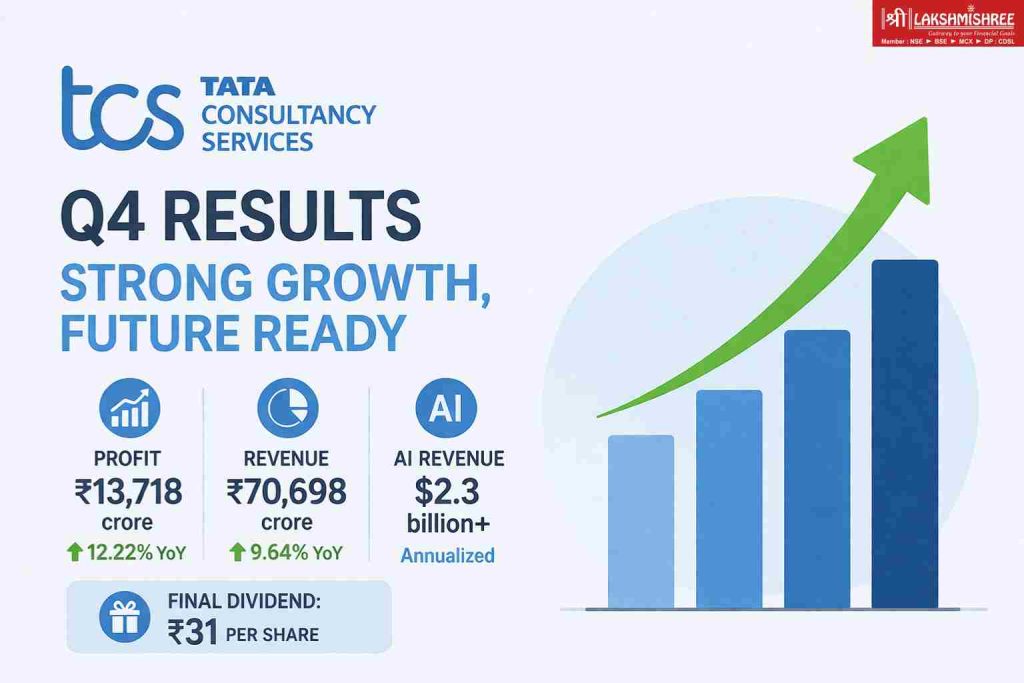
The company posted a 12.22% year-on-year increase in consolidated net profit to ₹13,718 crore for the March quarter, compared to ₹12,224 crore in the same period last year. On a sequential basis, profit rose sharply by nearly 29%, reflecting improved operational performance and deal execution.
Pasted text
Revenue from operations also remained robust, rising 9.64% year-on-year to ₹70,698 crore, supported by broad-based growth across key markets and industry verticals. Sequentially, revenue grew over 5%, indicating sustained demand despite global headwinds.
At the core of TCS’s performance is a clear strategic pivot toward AI-led transformation and large deal wins. The company reported strong momentum in securing mega deals, with total contract value (TCV) reaching around $12 billion during the quarter. Management emphasized that this reflects growing client confidence in long-term technology investments, particularly in areas such as cloud modernization, digital engineering and enterprise transformation.
CEO and Managing Director K. Krithivasan highlighted that this marks the third consecutive quarter of sequential growth, signaling stability in demand even in an uncertain global environment. The growth, he noted, was not limited to a single geography or sector but spread across multiple regions and industries.
A defining feature of the quarter was the accelerated adoption of AI solutions, which is beginning to reshape the company’s revenue mix. TCS reported that its annualized AI-related revenues have now crossed $2.3 billion, driven by increasing deployment of AI-led services across enterprise clients.
Pasted text
This shift is not merely incremental—it represents a structural transition. Investments in platforms such as HyperVault, along with strategic partnerships involving global technology players, are positioning TCS to capture the next wave of enterprise technology spending.
From a financial standpoint, the company demonstrated strong discipline. Despite increased investments in AI capabilities and acquisitions, operating margins expanded by 70 basis points, reflecting tight cost control and execution efficiency. Cash flows remained strong, reinforcing balance sheet resilience.
In line with its performance, TCS also announced a final dividend of ₹31 per share, signaling confidence in its financial position and commitment to shareholder returns.
Pasted text
On the workforce front, the company continues to align itself with future technology demands. Salary increments have been implemented across grades from April 1, alongside continued hiring and upskilling initiatives focused on building an AI-ready workforce.
However, the broader context remains complex. While demand for technology services is holding up, global economic uncertainties—including inflation, geopolitical risks and cautious enterprise spending—continue to act as underlying constraints.
The significance of TCS’s Q4 performance lies not just in the numbers, but in what they represent:
a company transitioning from traditional IT services to a platform-driven, AI-first enterprise partner.
As businesses globally accelerate digital transformation, the ability to combine scale, execution and emerging technologies will determine leadership. TCS’s latest results suggest that it is positioning itself firmly at that intersection.
Looking ahead, the sustainability of this momentum will depend on continued deal flow, execution of large contracts and the pace at which AI-led services translate into scalable, high-margin revenue streams.
For now, the message from the quarter is clear:
growth is intact, but it is evolving and TCS is adapting with it.

Kaashika is a social media strategist and financial content creator at Lakshmishree. She specialises in simplifying complex IPO and stock market concepts into clear, easy-to-understand content. Having created over 500+ pieces of financial content across reels, blogs, website posts and digital creatives, Kaashika helps audiences connect with the world of finance in a more accessible and engaging way.