Indian equity markets rallied sharply on Wednesday, with the Sensex soaring nearly 3,000 points and the Nifty approaching the 24,000 mark, as easing geopolitical tensions and a sharp fall in crude oil prices boosted investor sentiment, April 8, 2026.
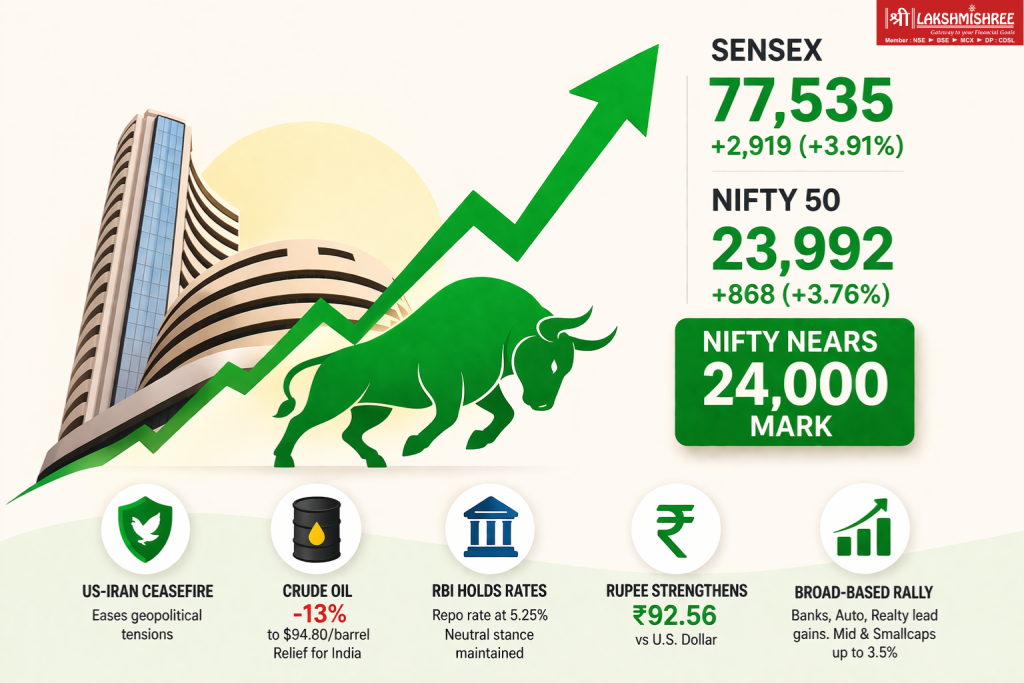
The BSE Sensex surged 2,919 points, or 3.91%, to 77,535 in mid-session trade, while the Nifty 50 climbed 868 points, or 3.76%, to 23,992—its highest level in nearly 11 months. The rally was broad-based, with market breadth strongly positive as a majority of stocks traded in the green.
The sharp upmove follows the announcement of a two-week ceasefire between the United States and Iran, which significantly eased concerns around global energy supply disruptions. The development marked a turning point for markets that had been under pressure due to prolonged geopolitical uncertainty.
A key trigger for the rally was the steep decline in crude oil prices. Brent crude fell over 13% to around $94.80 per barrel, offering relief to import-dependent economies like India. Lower oil prices are expected to ease inflationary pressures and reduce strain on the current account, supporting both currency stability and corporate margins.
Global cues also remained supportive. Asian markets, including Japan’s Nikkei and South Korea’s Kospi, traded higher, while U.S. futures indicated a strong opening. The improvement in global sentiment reinforced domestic momentum, attracting fresh buying across sectors.
Domestically, the Reserve Bank of India added to the positive sentiment by maintaining status quo on interest rates. The Monetary Policy Committee kept the repo rate unchanged at 5.25% and retained a neutral stance, signaling stability amid improving inflation conditions. Retail inflation has been trending closer to the central bank’s medium-term target, providing room for policy continuity.
The Indian rupee also strengthened, rising 50 paise to 92.56 against the U.S. dollar in early trade. The currency’s appreciation reflects easing external pressures and improved risk appetite among investors.
Sectorally, gains were led by banking, auto and realty stocks, which rose between 5% and 6%. Heavyweight financial stocks saw strong buying interest, indicating renewed confidence in domestic growth prospects. Among individual stocks, Larsen & Toubro advanced about 7%, while InterGlobe Aviation surged 10%, hitting its upper circuit limit and triggering a temporary trading halt.
Broader markets also participated in the rally, with midcap and smallcap indices gaining up to 3.5%, reflecting widespread investor participation.
Volatility indicators showed a decline, with the India VIX falling around 5% to 19.85, suggesting reduced market uncertainty. Lower volatility typically supports risk-taking behavior and sustained market momentum.
Analysts attribute the rally to a combination of easing geopolitical risks, declining crude prices and renewed value buying after recent market corrections. The ceasefire has altered near-term expectations, shifting focus from risk aversion to opportunity.
Despite the strong rebound, market participants remain cautious about the durability of the rally. Much will depend on the continuation of geopolitical stability and the sustainability of lower energy prices.
For now, however, the sharp recovery signals a decisive shift in sentiment, with markets responding quickly to improving global conditions and reaffirming their sensitivity to external triggers.

Kaashika is a social media strategist and financial content creator at Lakshmishree. She specialises in simplifying complex IPO and stock market concepts into clear, easy-to-understand content. Having created over 500+ pieces of financial content across reels, blogs, website posts and digital creatives, Kaashika helps audiences connect with the world of finance in a more accessible and engaging way.