
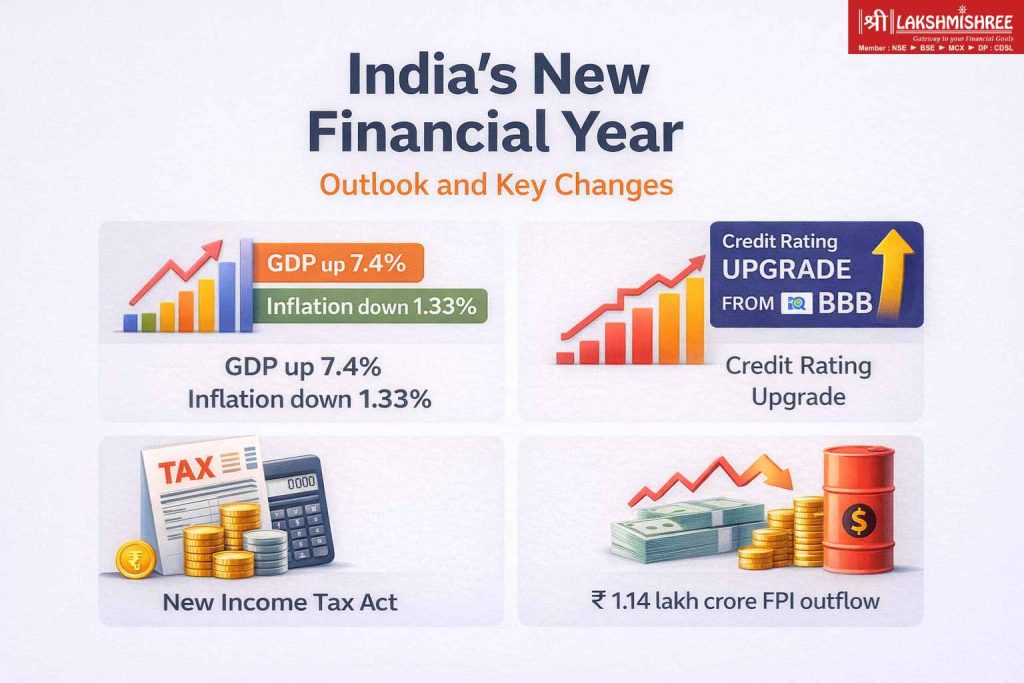
As FY 2025-26 draws to a close, India steps into a new financial year shaped by deep structural changes across taxation, financial markets and the broader economy. From a long-awaited sovereign credit rating upgrade to record foreign investor outflows and a complete rewrite of the income tax framework, the year has quietly but fundamentally altered how investors will navigate money going forward, March 30, 2026.
A strong economic base sets the tone
India’s economic performance remained resilient despite global uncertainty, providing a stable foundation for investors. The country recorded 7.4% real GDP growth, the fastest among major economies, while inflation cooled sharply to 1.33%, well below the central bank’s comfort zone.
This rare combination of high growth and low inflation has been crucial. It not only supports corporate earnings but also protects household purchasing power and allows interest rates to remain supportive for expansion. At the same time, the nature of growth has become more balanced. Private consumption rose to 61.5% of GDP, indicating that demand is increasingly being driven by households rather than relying solely on government spending.
Underlying this growth is a significant push in infrastructure and logistics. With thousands of projects underway, faster highway construction and improvements in rail and freight systems, the economy is building long-term capacity. These developments are not short-term triggers but structural drivers that strengthen the foundation of future growth and market stability.
Global confidence strengthens India’s standing
A major milestone during the year was India’s first sovereign credit rating upgrade in nearly two decades. The upgrade from BBB- to BBB has had a meaningful impact on how global investors perceive the country.
Lower borrowing costs and improved access to international capital have strengthened both government and corporate balance sheets. More importantly, the upgrade signals global confidence in India’s economic stability, creating a long-term tailwind for sectors such as infrastructure, banking and manufacturing.
Markets reflect a shift toward discipline
Equity markets during the year told a clear story. Instead of moving uniformly, they reflected a shift toward discipline and fundamentals. Large-cap indices delivered steady gains, while excessive optimism in smaller stocks corrected sharply.
Sectoral trends further highlighted this change. Financials, metals and automobiles benefited from improving balance sheets and demand recovery, while sectors such as IT, real estate and media faced pressure due to global slowdown, higher costs and structural challenges.
The broader takeaway was that returns were no longer driven by momentum alone. Investors increasingly rewarded earnings visibility, balance sheet strength and long-term growth potential.
March volatility tests market resilience
The final month of the financial year brought one of the most significant stress tests for Indian markets. Rising geopolitical tensions triggered sharp foreign investor outflows, with ₹1.14 lakh crore exiting equities. At the same time emerging from US-Iran war, crude oil prices surged above $100 per barrel and the rupee weakened to around ₹93 per dollar.
Despite these pressures, markets showed resilience. Domestic investors stepped in to absorb the selling, supported by strong and consistent mutual fund inflows. This marked a critical structural shift, indicating that Indian markets are no longer entirely dependent on foreign capital and have developed stronger internal support.
Policy changes reshape the investment environment
The new financial year beginning April 1, 2026, introduces several important changes that directly affect investors. The implementation of the new Income Tax Act replaces the decades-old framework with a simplified structure, aiming to improve clarity while tightening compliance.
At the same time, higher transaction costs in derivatives trading are expected to reduce speculative activity and encourage a more long-term investment approach. Interest rates appear to be stabilising, which could influence borrowing costs and returns in fixed-income investments. Additionally, a strong pipeline of large public offerings is expected to reshape market participation and capital flows.
Broader trends signal a changing economy
Beyond policy and markets, several broader trends defined the year. Gold emerged as one of the best-performing assets, reflecting investor preference for safety during uncertainty. Trade agreements with major global economies strengthened India’s export outlook, while the startup ecosystem moved toward advanced technologies such as artificial intelligence and deep-tech innovation.
Manufacturing also gained renewed focus, supported by policy initiatives and global supply chain shifts. These developments indicate that India’s growth story is becoming more diversified and globally integrated.
What this means for investors
The developments of FY 2025-26 point to a deeper transformation in how Indian markets function. Domestic investors are now playing a stabilising role, reducing dependence on foreign flows. At the same time, macroeconomic factors such as inflation, interest rates and global conditions are becoming more influential than short-term sentiment.
This shift also suggests that speculative trading is being structurally discouraged, while long-term sectors such as infrastructure, manufacturing and financials are gaining prominence. However, risks remain linked to global developments, including oil price volatility, currency movements and geopolitical uncertainty.
Outlook for FY 2026-27
Looking ahead, the economic outlook remains positive but balanced. Growth is expected to stay strong, while inflation is likely to move closer to more sustainable levels. Market performance is expected to be driven by sectors aligned with long-term economic priorities, including infrastructure, energy transition, financial services and manufacturing.
The focus is also expected to shift toward fundamentally strong large-cap companies, as investors become more selective in an environment shaped by both opportunity and caution.
The bigger picture
FY 2025-26 was not just another financial year. It marked a structural transition in how India’s economy and markets operate. Strong macro fundamentals, policy reforms and changing investor behaviour have collectively reshaped the investment landscape.
For investors, the message is becoming clearer. Markets are no longer driven solely by momentum or external capital. Instead, they are increasingly shaped by domestic participation, long-term fundamentals and policy direction.
As the new financial year begins, the focus moves beyond reacting to short-term volatility toward understanding deeper structural changes. These changes are likely to define India’s economic and investment trajectory for years to come.

Kaashika is a social media strategist and financial content creator at Lakshmishree. She specialises in simplifying complex IPO and stock market concepts into clear, easy-to-understand content. Having created over 500+ pieces of financial content across reels, blogs, website posts and digital creatives, Kaashika helps audiences connect with the world of finance in a more accessible and engaging way.