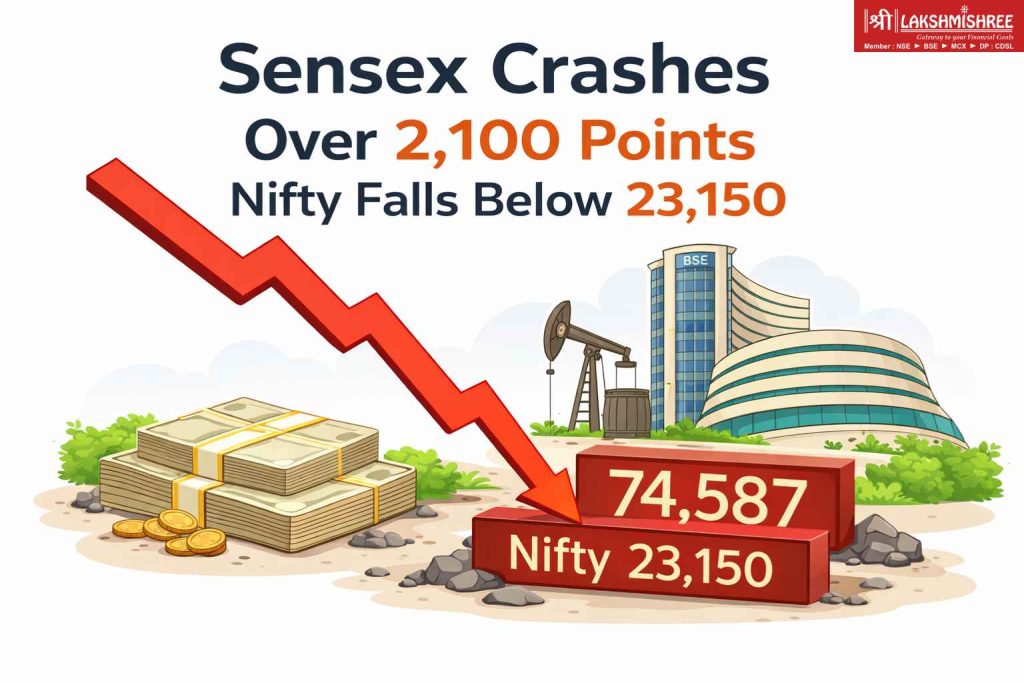
Indian equity markets came under severe pressure on Thursday, as a sharp escalation in the West Asia conflict combined with surging crude oil prices and global monetary tightening triggered a broad-based sell-off across Dalal Street. The Sensex crashed over 2,100 points to around 74,587 in afternoon trade, while the Nifty 50 slipped below 23,150, marking one of the sharpest intraday declines in recent months.
The sell-off began with a gap-down opening and deepened as the session progressed, wiping out more than ₹10 lakh crore in market capitalisation. Within minutes of opening, the Sensex had already fallen nearly 2,000 points, reflecting the intensity of global cues feeding into domestic markets.
At the core of this decline is a rapidly unfolding geopolitical and economic chain reaction. The escalation of the Iran conflict, including strikes on key energy facilities in the Gulf, has disrupted global energy sentiment and pushed Brent crude prices above $110–115 per barrel. For an import-dependent economy like India, this immediately raises concerns over inflation, trade balances and corporate profitability.
The impact of rising oil prices extends far beyond energy companies. Higher crude prices increase transportation and manufacturing costs, which eventually feed into consumer inflation. This creates pressure on interest rates, limits consumption and weakens earnings expectations — all of which are quickly reflected in equity valuations.
At the same time, the global financial environment has turned less supportive. The US Federal Reserve’s decision to keep interest rates elevated has strengthened the appeal of US bonds, prompting foreign investors to pull money out of emerging markets. This shift in global capital flows has intensified selling in Indian equities, particularly in large-cap stocks.
The market weakness has been widespread. Banking and financial stocks led the decline, pulling benchmark indices lower, while midcap and smallcap stocks also fell sharply, indicating that the correction is not limited to a few sectors but reflects a broader risk-off sentiment.
Global cues have further amplified the pressure. Asian markets declined significantly, tracking overnight losses on Wall Street, as investors reacted to both geopolitical risks and tighter financial conditions. This synchronized global sell-off has reduced risk appetite across markets, including India.
What makes the current situation significant is the way multiple global forces are converging at once. The conflict in West Asia is not just a geopolitical event; it is disrupting energy markets, influencing inflation expectations, altering central bank policies and redirecting global capital flows. These interconnected factors are now driving market behaviour more than individual company performance.
As a result, markets are reacting sharply to global developments, with every escalation in the conflict or movement in oil prices directly impacting investor sentiment. The volatility seen in today’s session reflects this shift, where uncertainty itself has become the dominant force shaping market direction.
With oil prices elevated and geopolitical tensions unresolved, analysts expect markets to remain highly sensitive to global developments. The current phase highlights how closely linked financial markets have become to geopolitical risks, where events thousands of miles away can quickly translate into significant economic and market consequences at home.

Kaashika is a social media strategist and financial content creator at Lakshmishree. She specialises in simplifying complex IPO and stock market concepts into clear, easy-to-understand content. Having created over 500+ pieces of financial content across reels, blogs, website posts and digital creatives, Kaashika helps audiences connect with the world of finance in a more accessible and engaging way.