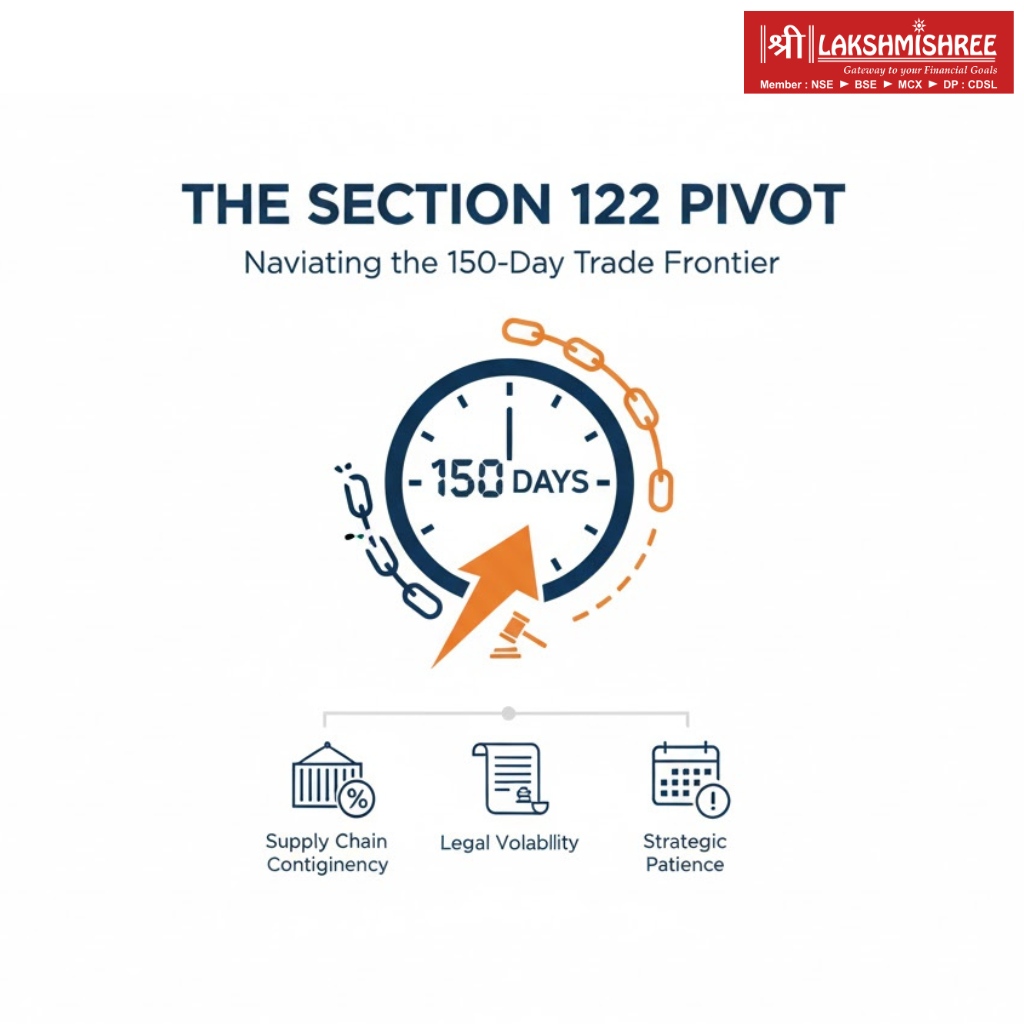
THE SECTION 122 PIVOT
Navigating the 150-Day Trade Frontier | Effective 10:31 AM IST
Strategic Realignment
The White House has transitioned from broad emergency powers to the legacy Section 122 of the 1974 Trade Act. This move secures a five-month window, yet creates a volatile floor for global corporate planning.
Bilateral Friction
India has officially postponed high-level talks. New Delhi’s cautious stance reflects the difficulty of finalizing interim deals while the baseline US tariff structure undergoes rapid legal fluctuations.
Agility as Alpha
From supply chain contingencies to monitoring secondary legal challenges, the current “watchful uncertainty” requires a shift from static planning to organizational agility.
Don’t Navigate the Horizon Alone
In an era where trade policy is rewritten in real-time, expert-led capital allocation is your only true north.
VISIT LAKSHMISHREE.COMThe global trade architecture experienced a significant structural shift this Tuesday as the US administration officially implemented a 10% across-the-board import tariff. This action, effective as of 10:31 AM IST, represents a strategic legal realignment following a landmark US Supreme Court ruling that invalidated previous executive trade mandates.
For institutional partners and global exporters, particularly in India, this move transforms a long-standing trade negotiation into a high-stakes legal and economic waiting game.
Strategic Legal Realignment
The White House has moved away from broad emergency powers, pivoting instead to Section 122 of the Trade Act of 1974. This specific provision allows for a 150-day temporary surcharge to address national balance-of-payment deficits. By utilizing this legacy statute, the administration has secured a five-month operational window to maintain its trade agenda without immediate congressional intervention.
However, this 150-day “temporary” status creates a volatile environment for corporate planning. Organizations must now account for the possibility of these rates being a baseline, with the administration already signaling a potential escalation to 15%.
Impact on Indo-US Bilateral Relations
The timing of this implementation has directly affected the momentum of bilateral trade discussions. Indian officials have opted to postpone high-level talks originally scheduled for this week in Washington. The rationale is clear: establishing long-term interim trade deals is inherently difficult when the underlying US tariff structure is subject to such rapid legal fluctuations.
New Delhi’s cautious stance reflects a broader institutional concern regarding the lack of clarity. Until the baseline duty is finalized and the threat of further legal challenges is mitigated, formalizing agreements remains a high-risk endeavor for the Ministry of Commerce.
Organizational Outlook and Risk Mitigation
The current market sentiment is defined by “watchful uncertainty.” The primary concern for global organizations is the expiration of this 150-day window. If the administration cannot secure a more permanent legal footing or congressional support by mid-summer, the trade landscape could undergo yet another drastic shift.
Key Considerations for Stakeholders:
- Supply Chain Contingency: Evaluating the impact of a 10% vs. 15% tariff on landed costs for US-bound exports.
- Legal Volatility: Monitoring the potential for secondary legal challenges against the use of Section 122.
- Strategic Patience: Aligning with the current trend of pausing major negotiations until the 150-day roadmap is clearly defined.
The “Section 122 Pivot” is more than a simple tax implementation; it is a test of organizational agility in an era where trade policy is being rewritten in real-time. For now, the global market must wait for the dust to settle on this new, albeit fragile, legal home for US trade policy.

Kaashika is a social media strategist and financial content creator at Lakshmishree. She specialises in simplifying complex IPO and stock market concepts into clear, easy-to-understand content. Having created over 500+ pieces of financial content across reels, blogs, website posts and digital creatives, Kaashika helps audiences connect with the world of finance in a more accessible and engaging way.