
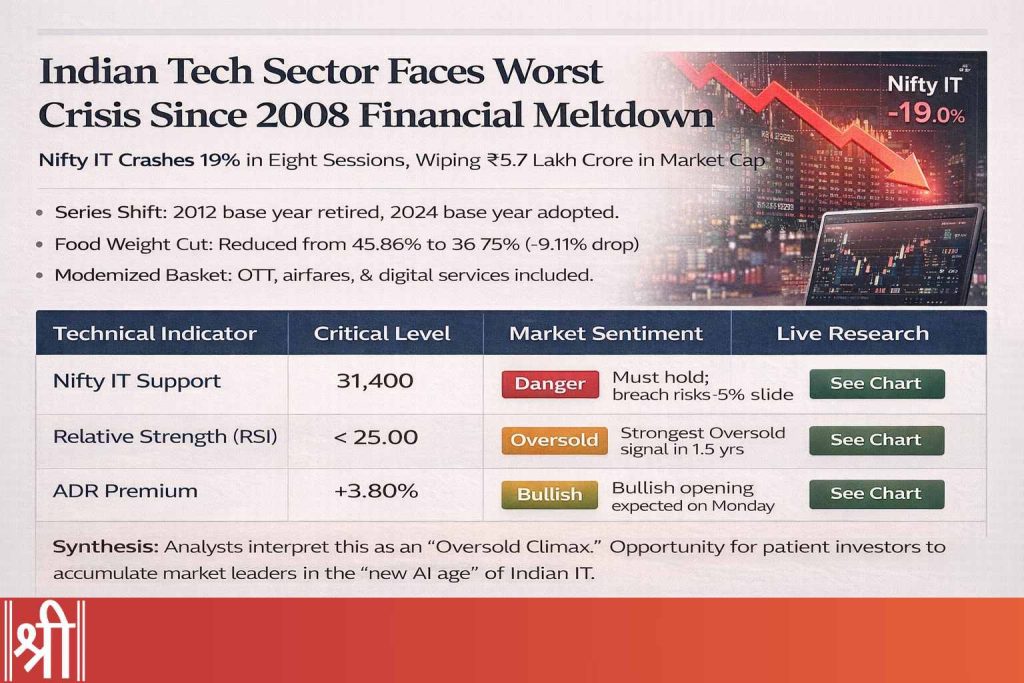
The Indian technology sector is currently navigating its most significant valuation crisis since the 2008 Global Financial Crisis. Over an intense eight-session period, the Nifty IT Index collapsed by 19%, vaporizing ₹5.7 lakh crore (approx. $68 billion) in market capitalization. While headline numbers focus on the “rout,” a forensic analysis of the underlying data suggests this is not a simple market correction, but a fundamental repricing of the Indian offshore delivery model.
1. The Productivity Paradox: Decoding the “Anthropic Shock”
The primary trigger for this massive liquidation was the commercial release of advanced autonomous agents by Silicon Valley’s Anthropic. These tools, capable of handling complex compliance, UI debugging, and legal workflows, have directly threatened the linear billing model, the bedrock of Indian IT services.
- Manpower Erosion: Historically, revenue for firms like TCS and Wipro has been tied to headcount. If AI-driven automation reduces the requirement of five junior developers to one senior supervisor, the traditional volume-based growth trajectory breaks.
- The TCS Benchmark: For the first time in over five years, TCS market capitalization dipped below ₹10 lakh crore. This breach of psychological and technical support indicates that the market is no longer pricing these firms as growth stocks, but as utility providers undergoing a structural shift.
2. The Infrastructure Plumbers Thesis: A Case for Deep Value
Despite the panic, a critical analysis of global enterprise architecture reveals a different story. Large-scale global corporations (Fortune 500) cannot simply “switch on” AI.
- Integration Complexity: Modern software stacks are incredibly fragmented. Even if an AI agent can generate code, the integration, security auditing, and maintenance of that code remain human-intensive. Indian IT firms are effectively the “plumbers” of the digital age; they manage the complex subterranean data pipes that AI cannot yet touch.
- Valuation Anomalies: Current price-to-earnings (P/E) multiples for mid-cap IT firms like Coforge and LTIMindtree have reached decadal lows. At these levels, the dividend yields and free cash flow (FCF) yields are mirroring the “crisis pricing” seen during the 2020 pandemic lockdowns, offering a significant margin of safety for value investors.
3. Macroeconomic Cross-Currents: The US Squeeze
The AI fear is being compounded by a classic macroeconomic squeeze from the United States, which accounts for nearly 60% of the sector’s revenue.
- Labor Resilience vs. Rate Cuts: Recent US employment data has shown unexpected strength, effectively postponing the “Rate Cut Cycle” that the IT sector was banking on.
- Discretionary Freeze: When the cost of capital remains high, US Chief Information Officers (CIOs) prioritize “Run-the-Business” (maintenance) over “Change-the-Business” (new digital transformation). This has resulted in a temporary freeze on high-margin discretionary projects.
4. Technical Outlook: The Monday Rebound Scenario
The 4% rebound in Infosys and Wipro ADRs during the Friday night US session provides a lead indicator for Monday’s domestic open.
| Technical Indicator | Critical Level | Market Sentiment | Live Research |
|---|---|---|---|
| Nifty IT Support | 31,400 | Must hold; breach risks -5% slide | See Chart |
| Relative Strength (RSI) | < 25.00 | Strongest Oversold signal in 1.5 yrs | See Chart |
| ADR Premium | +3.80% | Bullish opening expected on Monday | See Chart |
The consensus among seasoned analysts is that we are witnessing an “Oversold Climax.” While the sector must reinvent itself by moving from “headcount-based” to “outcome-based” pricing, the current sell-off assumes a worst-case scenario where Indian IT becomes obsolete—a premise that ignores the massive, ongoing demand for legacy system maintenance.
The Bottom Line
This is the “New Birth” of the Indian IT sector. We are transitioning from a world of writing code to a world of orchestrating AI systems. The current bloodbath is a violent adjustment to this new reality. For disciplined investors, this period represents a rare opportunity to accumulate market leaders at valuations that assume zero future growth—a scenario rarely sustained in the technology space.

Kaashika is a social media strategist and financial content creator at Lakshmishree. She specialises in simplifying complex IPO and stock market concepts into clear, easy-to-understand content. Having created over 500+ pieces of financial content across reels, blogs, website posts and digital creatives, Kaashika helps audiences connect with the world of finance in a more accessible and engaging way.