
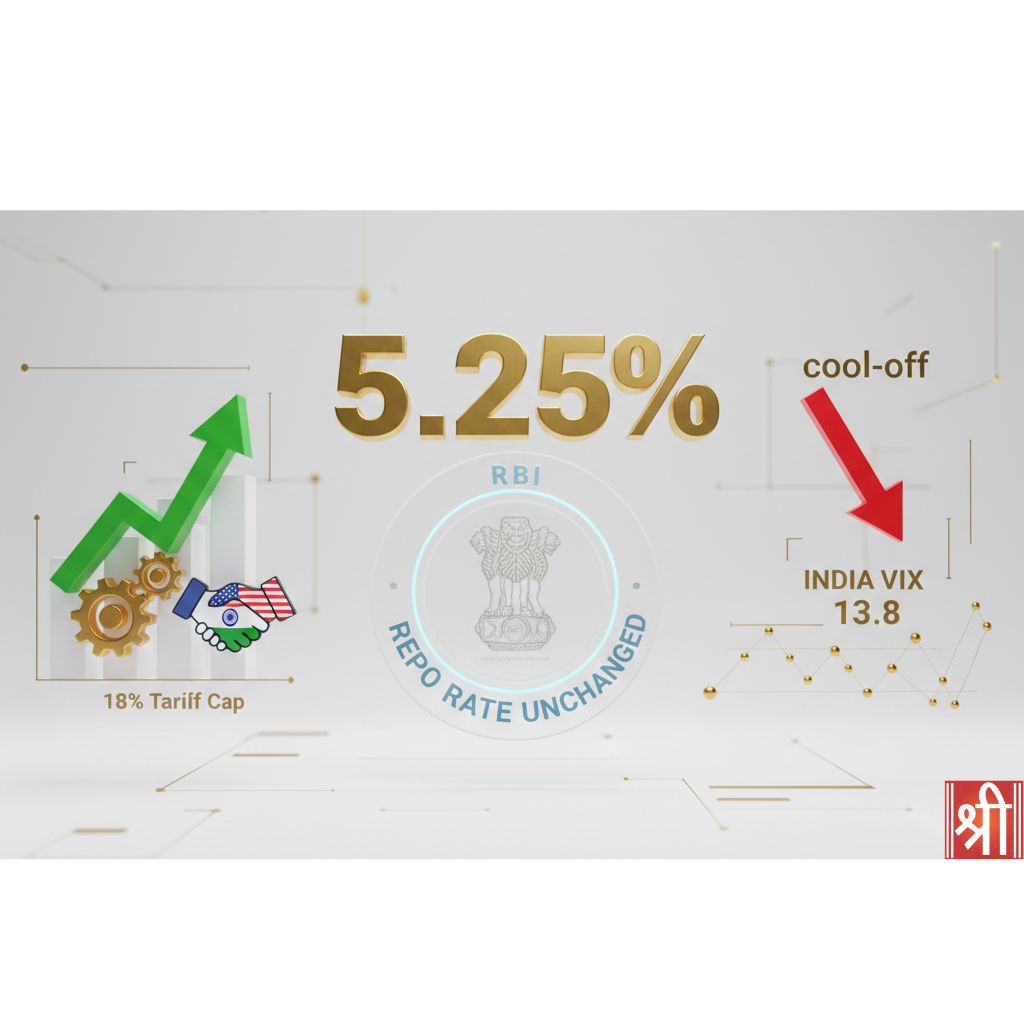
The Reserve Bank of India’s (RBI) Monetary Policy Committee (MPC) voted unanimously Friday to maintain the benchmark repo rate at 5.25%, signaling a tactical pause as the central bank navigates a complex intersection of domestic fiscal consolidation and a historic realignment in global trade.
Led by Governor Sanjay Malhotra, the six-member committee concluded its final bi-monthly meeting of the 2026 fiscal year by retaining its “neutral” stance. The decision meets the consensus of Tier-1 analysts who projected a status quo following a cumulative 125-basis-point reduction in the repo rate since Feb. 2025. Consequently, the Standing Deposit Facility (SDF) rate remains at 5%, while the Marginal Standing Facility (MSF) and the Bank Rate are fixed at 5.5%.
The Policy Pivot: Prioritizing Liquidity Over Rate Cuts
The RBI’s decision to hold rates reflects a pivot toward liquidity management rather than further aggressive easing. While the central bank had been on a decisive downward trajectory—slashing rates by 25 basis points in Dec. 2025, the current macro backdrop has been fundamentally altered by the Union Budget 2026 and the landmark India-U.S. trade accord.
“The committee noted that since the last policy meeting, external headwinds have intensified, though the successful completion of trade deals augurs well for the economic outlook,” Governor Malhotra stated during the policy briefing.
Economists observe that the government’s ₹17.2 trillion gross borrowing programme for FY27, announced in the Feb. 1 Budget, makes yield-curve stability a priority for the central bank. With the fiscal deficit target set at 4.3%, the RBI is expected to focus on managing system liquidity and bond-market spreads rather than further lowering the cost of credit.
External Buffers: Trade Deals as Macro Stabilizers
A defining factor in the MPC’s calculus is the recent de-escalation of trade friction. The India-U.S. trade deal, which established an 18% tariff ceiling on Indian exports and scrapped a 25% punitive penalty, has provided a significant external growth stimulus.
Combined with the India-EU FTA signed on Jan. 27, India now possesses one of the lowest tariff rates among Asian peers. This structural advantage is expected to support capital inflows and bolster the Indian rupee (INR), which staged a recovery to the 90.20–90.30 range this week after breaching the 92 level in January. The removal of the “tariff-overhang” reduces the pressure on the RBI to intervene in currency markets, providing the central bank with additional flexibility to manage domestic liquidity.
Inflation and Growth: The Delicate Balance
Headline inflation remains within the RBI’s tolerance band, with Nov. and Dec. figures printing below the target. However, the MPC revised its CPI inflation outlook slightly upward for the first half of the next fiscal year, projecting 4% for Q1 and 4.2% for Q2.
The growth narrative continues to be supported by a record ₹12.2 trillion capital expenditure allocation in the Budget. While Mukesh Ambani, Chairman of Reliance Industries, recently projected that 8% to 10% sustained growth is achievable, the RBI maintained a more tempered outlook, focusing on the “heterogeneous” nature of global inflation and escalating geopolitical friction.
Market Reaction and Sectoral Outlook
Benchmark indices, the NSE Nifty 50 and S&P BSE Sensex, cooled slightly following the announcement, reflecting a consolidation phase after the massive 3% gap-up rally on Tuesday. By Thursday’s close, the Sensex had retreated 0.60% to settle at 83,313.93, while the Nifty declined 0.52% to 25,642.80, as traders locked in profits ahead of the policy outcome.
- Banking Sector: The Bank Nifty index retreated 0.47% to 59,957.95, as participants adjusted to the “wait-and-watch” mode of the MPC.
- IT Services: The sector remains under duress, with the Nifty IT index plunging nearly 7% earlier this week due to the “Anthropic Effect”—a sell-off triggered by new AI automation tools that threaten traditional software service models.
- Manufacturing and Exports: The 18% tariff cap continues to provide long-term “earnings visibility” for textiles and auto ancillaries, serving as a fundamental floor for valuations despite near-term volatility.
Conclusion: A Tactical Breath in a High-Velocity Market
The RBI’s decision to extend the rate pause represents a tactical breath in an otherwise high-velocity financial ecosystem. By absorbing the mechanical shock of the Budget’s tax revisions including the STT hike on derivatives and leveraging the geopolitical dividend of the U.S. trade pact, India has stabilized its macro-financial framework.
The India VIX has cooled to 13.8, indicating that the policy-related “fear premium” has dissipated. Investors are advised to monitor the execution of the $500 billion trade commitment with the U.S., as the RBI appears content to let current rates work through the system while transmission to bank lending rates remains in progress.

Kaashika is a social media strategist and financial content creator at Lakshmishree. She specialises in simplifying complex IPO and stock market concepts into clear, easy-to-understand content. Having created over 500+ pieces of financial content across reels, blogs, website posts and digital creatives, Kaashika helps audiences connect with the world of finance in a more accessible and engaging way.