As Finance Minister Nirmala Sitharaman prepares to table the Union Budget 2026 on Feb. 1—the first time in recent history the document will be presented on a Sunday—the overarching theme is one of disciplined continuity. Market participants and economists expect a pivot away from aggressive pandemic-era spending toward a rigid fiscal consolidation path, with the debt-to-GDP ratio likely replacing the fiscal deficit as the primary anchor for India’s long-term sovereign credit profile.
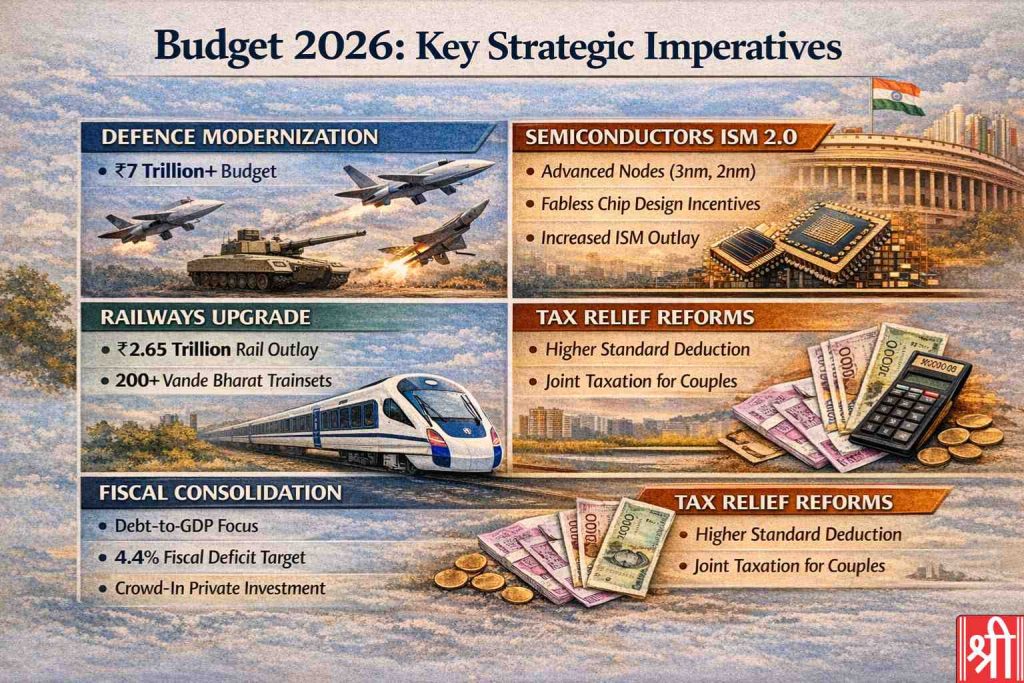
The consensus among Tier-1 analysts points to a fiscal deficit target of approximately 4.4% for FY27. This fiscal restraint is expected to be paired with a calibrated 10% to 15% increase in capital expenditure, pushing the total outlay to an estimated ₹12.2 trillion. The strategy is clear: maintain the pace of infrastructure development while crowding in private investment to sustain a projected GDP growth of 7% to 7.5%.
Defence: Post-‘Operation Sindoor’ Modernization
The defence sector remains a cornerstone of the national agenda, particularly following the successful execution of Operation Sindoor in May 2025. This military initiative, launched in response to the Pahalgam terror attack, has fundamentally altered the budgetary narrative from routine maintenance to fast-tracked technological upgrades.
Reports suggest a potential supplementary allocation of ₹50,000 crore, which would drive the total defence outlay beyond ₹7 trillion. A critical 70% of this capital budget is expected to be earmarked for domestic procurement.
- Key Focus: UAVs, loitering munitions, and counter-drone systems.
- Stocks to Watch: Hindustan Aeronautics Ltd. (HAL), Mazagon Dock, and Bharat Electronics Ltd. (BEL).
Semiconductors and Electronics: Transition to ISM 2.0
With four semiconductor plants scheduled to begin commercial production in 2026, the government is moving from “policy signaling” to “execution.” The India Semiconductor Mission (ISM) 2.0 is expected to be a highlight of the Budget, with a draft proposal currently undergoing final inter-ministerial vetting.
Sources indicate the new mission may feature a higher outlay than the initial ₹76,000 crore, specifically targeting:
- Advanced Nodes: Roadmaps for 3-nanometre and 2-nanometre technology.
- Fabless Ecosystem: Support for at least 50 domestic fabless chip design firms.
- Market Impact: Positive tailwinds for Moschip Technologies and Tata Elxsi.
Railways: The Semi-High-Speed Upgrade
Railway infrastructure continues to see strong execution, with 80% of the FY26 allocation of ₹2.52 trillion utilized by December 2025. For the upcoming fiscal year, experts anticipate a 5% increase in the rail outlay to roughly ₹2.65 trillion.
The focus will shift from simple track expansion to safety and signaling upgrades (Kavach 2.0) to support the rollout of 200 Vande Bharat and 50 Namo Bharat trainsets. Stocks such as RVNL and IRCON International are likely to see continued volatility as contract execution timelines are scrutinized.
Real Estate and Housing: Reviving Affordable Demand
The real estate sector enters 2026 following four consecutive quarters of declining housing sales, with demand primarily confined to luxury segments. To bridge this gap, industry bodies like CREDAI are advocating for a redefinition of “affordable housing,” pushing the cap from ₹45 lakh to as high as ₹85 lakh in metro regions.
Projected Interventions:
- PMAY Outlay: Expectations for a substantial increase in the Pradhan Mantri Awas Yojana (PMAY) budget, which stood at ₹78,126 crore (BE) for FY26.
- Tax Relief: A potential hike in the Section 24(b) home loan interest deduction from ₹2 lakh to ₹4–6 lakh.
- Beneficiaries: Affordable housing plays like Godrej Properties and Puravankara.
Electric Mobility and Green Energy
India’s EV adoption surpassed 2.3 million units in 2025, and the momentum is now tied to the PM E-DRIVE scheme, which carries an outlay of ₹10,900 crore through 2028. Analysts expect Budget 2026 to introduce fresh incentives for domestic battery “gigafactories” and a uniform 5% GST rate across all EV components to reduce manufacturing friction.
In the renewable segment, the extension of the Production Linked Incentive (PLI) scheme to the entire solar value chain—including grid equipment—is a primary industry demand to meet net-zero targets.
Consumption and Personal Taxation
To stimulate uneven urban demand, there is significant pressure on the Finance Ministry to increase the standard deduction for salaried employees. Proposals range from the current ₹75,000 (new regime) to ₹1,00,000 to offset inflationary pressures. Additionally, the introduction of a joint taxation framework for married couples is being discussed as a compliance-easing measure.
“The Budget is more likely to prioritize accelerating structural reforms than unveiling big-ticket spending programs,” says Vinit Sambre, Head of Equities at DSP Mutual Fund. “The goal is to provide a stable fiscal environment that encourages private capex.”
Summary Table: Key Sectoral Expectations
| Theme | Focus Area | Market Expectation |
| Defence | Indigenization | ₹50,000 Cr supplementary hike |
| Railways | Safety & Speed | ₹2.65 trillion total outlay |
| Tech/Semi | ISM 2.0 | Outlay exceeding ₹76,000 Cr |
| Real Estate | Affordability | Revised price caps for metros |
| Fiscal | Consolidation | 4.4% Deficit / 50% Debt-to-GDP |

Kaashika is a social media strategist and financial content creator at Lakshmishree. She specialises in simplifying complex IPO and stock market concepts into clear, easy-to-understand content. Having created over 500+ pieces of financial content across reels, blogs, website posts and digital creatives, Kaashika helps audiences connect with the world of finance in a more accessible and engaging way.