In a document that serves as both a badge of resilience and a roadmap for navigating a fractured world, the Government of India tabled the Economic Survey 2025-26 in Parliament on Thursday, January 29. Tabled by Union Finance Minister Nirmala Sitharaman and authored by Chief Economic Advisor V. Anantha Nageswaran, the Survey presents a picture of a confident India upgrading its growth potential while simultaneously issuing a stark warning about a global economy teetering on the edge of a “systemic shock.”
The Survey has projected a real GDP growth range of 6.8% to 7.2% for FY27, building on a robust estimate of 7.4% for the current fiscal year (FY26). More significantly, it has structurally upgraded India’s medium-term growth potential to 7%, up from the 6.5% estimate provided in 2022-23.
However, this domestic optimism is framed against a grim international backdrop. The document outlines a “paradox of 2025,” noting that India’s strongest macroeconomic performance in decades is colliding with a global system that no longer rewards success with stability, but instead presents compounding geopolitical and financial risks.
The Domestic Upgrade: Why 7% is the New Normal
The upgrade in India’s medium-term growth outlook is not merely statistical optimism but is rooted in tangible structural shifts. The Survey attributes this newfound gear to a “trinity” of drivers: the strengthening of corporate and financial sector balance sheets, sustained public capital expenditure, and the fruition of manufacturing initiatives like the Production-Linked Incentive (PLI) schemes.
“India is now anticipating a full-year real growth rate of over 7%, with another year of real growth at or near 7%,” the Survey notes. It highlights that the reform momentum—specifically in logistics, FDI liberalisation, and tax administration—has coincided with the rising formalisation of employment.
Crucially, the Survey points out that the Indian banking system is healthier than it has been in years, ready to support credit demand. With private consumption rising and the “bottom 10%” seeing sharp improvements in welfare, the domestic engine is firing on multiple cylinders.
The Global Warning: Three Scenarios for 2026
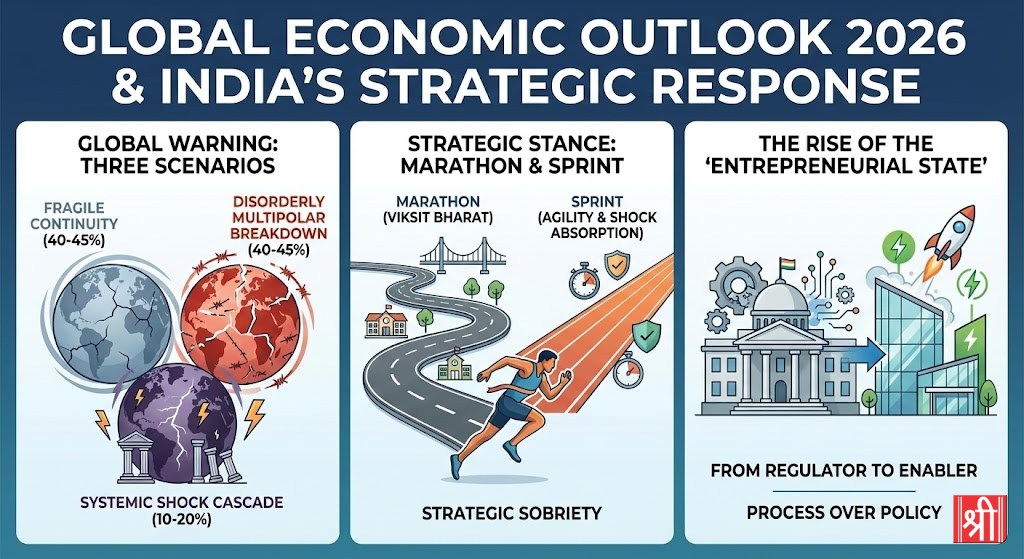
While the domestic view is sunny, the Survey’s assessment of the external environment is arguably the most bearish in recent history. It posits three potential scenarios for the global economy in 2026, none of which offer smooth sailing.
1. Fragile Continuity (40-45% Probability): The most likely scenario sees a continuation of the 2025 status quo, but in an “increasingly less secure” manner. The world remains integrated but distrustful, characterized by managed disorder rather than cooperation.
2. Disorderly Multipolar Breakdown (40-45% Probability): Equally likely is a breakdown where strategic rivalries intensify. The Survey warns of trade becoming “explicitly coercive,” with sanctions proliferating and supply chains being weaponized. In this world, nations will be forced to choose between autonomy and growth.
3. The Systemic Shock Cascade (10-20% Probability): The bleakest scenario—a “tail risk” that is no longer negligible—envisions a crisis potentially worse than the 2008 Global Financial Crash. The Survey warns that financial, technological, and geopolitical stresses could amplify one another. Specifically, it flags highly leveraged investments in Artificial Intelligence (AI) as a vulnerability, noting that a correction in AI valuations could trigger a tightening of global financial conditions.
Strategic Stance: “Marathon and Sprint”
To navigate this volatility, the Economic Survey introduces a compelling metaphor for policymakers: India must “run a marathon and sprint simultaneously.”
This dual approach necessitates a shift in how the state operates. The “marathon” represents the long-term pursuit of Viksit Bharat (Developed India) through infrastructure and human capital development. The “sprint” refers to the agility required to react to sudden external shocks—be it currency volatility, supply chain disruptions, or geopolitical realignments.
The Survey explicitly mentions the need for “Strategic Sobriety.” It argues that India cannot rely on global stability to drive its growth. Instead, it must generate sufficient investor interest and export earnings to cover a rising import bill. “Regardless of indigenisation efforts, rising imports will invariably accompany rising incomes,” the document states, underscoring the need to protect the Rupee through robust foreign exchange reserves and export competitiveness.
The Rise of the “Entrepreneurial State”
Perhaps the most significant philosophical shift in the Survey is the call for “Entrepreneurial Policy Making.” The CEA argues that in an era of uncertainty, the government cannot wait for perfect clarity before acting.
“The State requires a deeper shift… a state that can act before certainty emerges, structures risk rather than avoids it, and corrects course without paralysis,” the Preface reads.
The document cites recent successes—such as the mission-mode approach to semiconductors and Green Hydrogen—as evidence that the Indian state is evolving from a regulator to an enabler. It praises state-level deregulation efforts that have replaced “inspection-based control” with “trust-based compliance,” signalling a move from bureaucratic compliance to genuine state capability.
Process Over Policy
In a nuanced critique of governance, the Survey emphasizes that “Process reforms arguably matter more than policy reforms.” While policy sets the intent, the process defines the interaction between the government and the citizen. The document argues that for India to navigate the “hostile terrain” of the 2020s, the administrative machinery must reinvent itself to facilitate, rather than obstruct, the private sector and households.
Risks to the Outlook
Despite the upgrades, the Survey is candid about the risks. The primary vulnerability remains the external sector. Whether it is a disorderly geopolitical breakdown or a financial crash, the common risk for India is the “disruption of capital flows and the consequent impact on the Rupee.”
Furthermore, the document notes the impact of tariffs imposed by the United States in April 2025, suggesting that the era of free trade is largely over. In this context, India’s ability to maintain strategic autonomy while remaining deeply integrated into the global economy will be its defining challenge.
Conclusion
The Economic Survey 2025-26 serves as a bridge between economic diagnosis and fiscal prescription. It sets the stage for the Union Budget by establishing a clear narrative: India is an outlier of growth in a slowing world, but it is not immune to gravity.
As the country prepares for the Budget presentation, the Survey’s message is clear. The days of easy global growth are over. To sustain its 7% trajectory, India must rely on internal engines—investment, efficiency, and an agile, entrepreneurial state—while keeping its defenses high against a global storm that may be just over the horizon.

Kaashika is a social media strategist and financial content creator at Lakshmishree. She specialises in simplifying complex IPO and stock market concepts into clear, easy-to-understand content. Having created over 500+ pieces of financial content across reels, blogs, website posts and digital creatives, Kaashika helps audiences connect with the world of finance in a more accessible and engaging way.