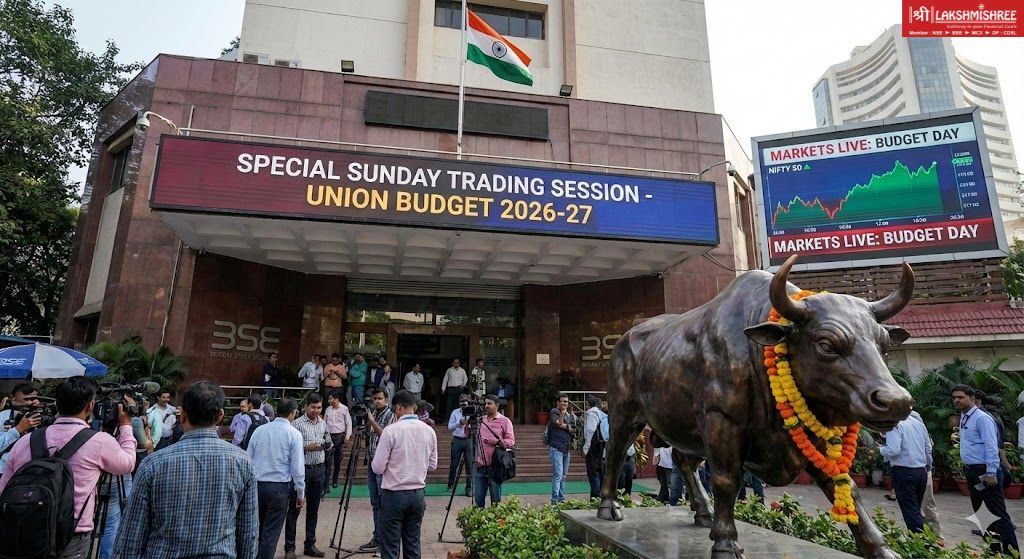
In a move that underscores the critical economic weight of the Union Budget 2026, Indian stock markets are set for a rare Sunday trading session. The National Stock Exchange (NSE) and Bombay Stock Exchange (BSE) have confirmed that trading will remain open on February 1, 2026, to align with Finance Minister Nirmala Sitharaman’s presentation of the Union Budget 2026 for the fiscal year 2026-27.
While weekends are typically non-trading days, this special session breaks from the norm to ensure real-time price discovery as one of the year’s most significant economic events unfolds.
Why a Sunday Session? The Economics of Real-Time Reaction
The decision to keep markets open is driven by the need to manage volatility and facilitate immediate market responses. The Union Budget is a definitive document outlining the government’s fiscal roadmap, taxation policies, and sector-specific allocations. These announcements have instantaneous implications for corporate profitability, sector growth, and overall market sentiment.
Historically, deferring the market reaction to the next working day (Monday) has often led to pent-up volatility and gap-up or gap-down openings that can disorient retail investors. By keeping the window open during the speech, exchanges allow information to be absorbed gradually. Investors can adjust their portfolios in real-time as policy details—such as changes in capital gains tax, infrastructure spending, or fiscal deficit targets—are revealed.
This practice is not without precedent. Markets previously operated on Saturday, February 1, 2020, and Saturday, February 28, 2015, to coincide with Budget presentations. However, a Sunday session remains an exceptional event in the history of Dalal Street, marking the first time since Independence that the Union Budget is being presented on a Sunday.
Market Schedule: Business as Usual
Despite the unusual day, the trading schedule will mirror a standard business day. According to circulars issued by the NSE and BSE:
- Pre-Open Session: 9:00 AM to 9:08 AM
- Normal Trading Session: 9:15 AM to 3:30 PM
- Segments: All major segments, including Equities, Derivatives (F&O), and Currency Derivatives, will be operational. Commodity markets (MCX) 9:00 AM to 5:00 PM remain open to reflect the impact of customs duty changes on precious metals and energy.
It is important to note that settlement cycles may be adjusted, and certain specialized sessions like the “T+0 Settlement” or auction sessions for settlement defaults will likely be suspended for the day.
Navigating Volatility: The “Budget 2026 Day” Phenomenon
Trading on Budget Day is characterized by high drama and sharp intraday swings. Historical data from Samco Securities indicates that while the average closing change on Budget Day might be muted (approx. 0.19% for Nifty), the intraday range can be as high as 2.65%, offering massive opportunities—and risks—for traders.
What Moves the Needle? Markets are forward-looking mechanisms that price in expectations weeks in advance. On Sunday, the immediate reaction will likely hinge on:
- Fiscal Prudence: Any deviation from the fiscal consolidation glide path (targeting a deficit of ~4.2% of GDP) could spook bond markets and banking stocks.
- Capex vs. Populism: With 2026 being a politically sensitive year, a tilt towards populist welfare schemes over capital expenditure could dampen sentiment in infrastructure and manufacturing sectors.
- Taxation: Any tinkering with the Long Term Capital Gains (LTCG) tax or Securities Transaction Tax (STT) typically triggers knee-jerk reactions.
Sectoral Watch:
- Infrastructure & Power: Stocks like L&T, NTPC, and Siemens are in focus on expectations of sustained capex.
- Banking (Bank Nifty): High sensitivity to borrowing targets and bond yields makes this the most volatile index on Budget Day.
- Rural & Consumption: Companies like Hindustan Unilever and M&M could see action if rural allocation is boosted.
Strategy for Investors: Caution vs. Opportunity
For the retail investor, the Sunday session for Budget 2026 requires discipline. The initial reaction to a headline can often be misleading; markets frequently reverse direction once the “fine print” is analyzed post-speech.
- Traders: Expect high premiums in options due to elevated Implied Volatility (IV). Stop-losses are crucial as whipsaw movements are common.
- Long-Term Investors: This session offers a chance to buy quality stocks if knee-jerk reactions cause unjustified corrections. The focus should remain on the structural story—India’s manufacturing push, energy transition, and credit growth—rather than single-day noise.
The Bottom Line The open market this Sunday is a testament to the Budget’s centrality in India’s economic narrative. While the novelty of trading on a holiday adds excitement, the fundamental rules remain unchanged: volatility is guaranteed, but clarity often comes only after the dust settles. As the Finance Minister rises to speak at 11:00 AM, millions of charts will flicker to life, marking a historic Sunday on Dalal Street.

Kaashika is a social media strategist and financial content creator at Lakshmishree. She specialises in simplifying complex IPO and stock market concepts into clear, easy-to-understand content. Having created over 500+ pieces of financial content across reels, blogs, website posts and digital creatives, Kaashika helps audiences connect with the world of finance in a more accessible and engaging way.