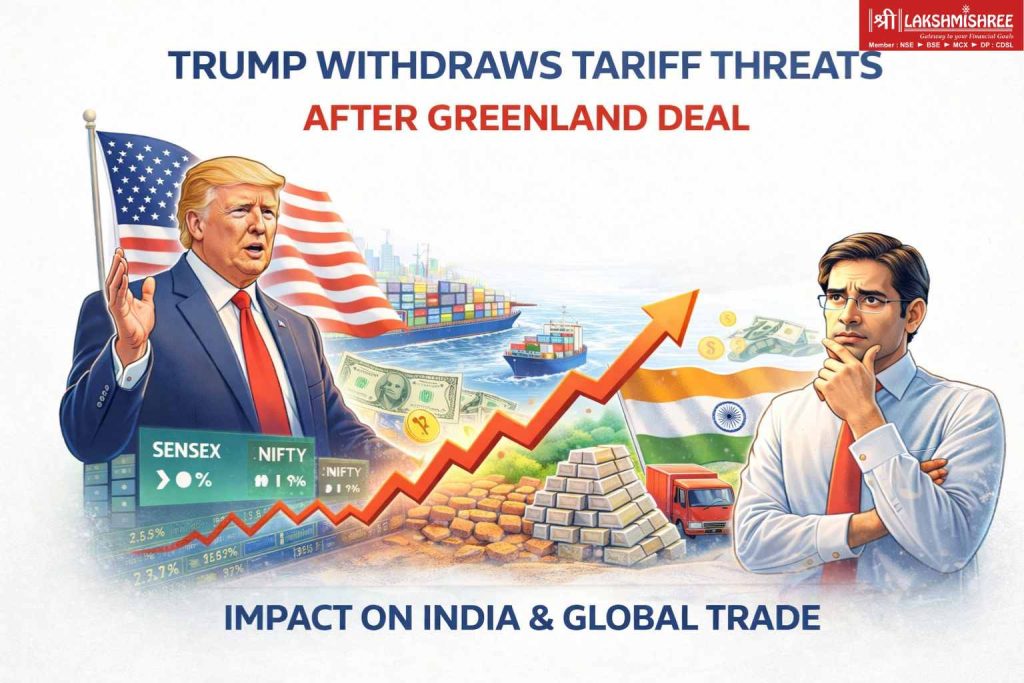
U.S. President Donald Trump has withdrawn his recent tariff threats against several countries after announcing a “framework deal” with NATO allies on issues linked to Greenland. The decision has brought immediate relief to global markets and is being closely watched in India, where trade, exports, and financial markets are highly sensitive to shifts in U.S. tariff policy.
The development marks a pause in what many feared could turn into another round of Trump tariff-driven trade tensions, a theme that has repeatedly disrupted global commerce in the past.
What Happened: Trump Tariffs Put on Hold
Earlier this month, President Trump had warned of fresh tariffs on select nations if U.S. strategic interests were not addressed. These statements revived concerns of a broader trade conflict, similar to earlier Trump-era tariff actions on steel, aluminium, and other imports.
However, following discussions with NATO leadership, Trump said the U.S. had reached a framework understanding on cooperation related to Greenland and Arctic security. Soon after, the White House confirmed that the proposed tariff threats would not move forward, at least for now.
Markets interpreted this as a de-escalation, leading to a positive reaction across global equities.
Why Trump Tariff News Matters to India
Even when India is not directly targeted, Trump tariffs influence India through global trade channels.
Impact on Indian Exports
India’s export sectors — including IT services, pharmaceuticals, auto components, metals, and textiles which depend heavily on demand from the U.S. and Europe. Any escalation in U.S. tariffs typically leads to:
- Slower global growth expectations
- Reduced export orders
- Increased uncertainty for Indian businesses
The withdrawal of tariff threats improves sentiment for Indian exporters, especially those already facing pressure from global slowdown concerns.
Stock Market and Investor Sentiment
Indian equity markets react sharply to Trump tariff headlines. Previous tariff announcements have triggered:
- Volatility in Sensex and Nifty
- Selling by foreign institutional investors (FIIs)
- Pressure on export-oriented stocks
The easing of tariff fears has helped stabilise foreign inflows into Indian markets, supporting broader market sentiment.
Currency and Inflation Effects
Trump tariffs often push up global commodity prices and disrupt supply chains. For India, this can mean:
- Higher import costs
- Pressure on the rupee
- Imported inflation
With tariff risks temporarily off the table, inflationary pressures from global trade disruptions are reduced.
Global Context: Greenland and Strategic Negotiations
Internationally, Greenland has gained importance due to its strategic location, mineral resources, and Arctic trade routes. Trump’s earlier statements had raised diplomatic tensions with U.S. allies, particularly in Europe.
The framework deal announced by Trump appears aimed at securing U.S. strategic interests without triggering a wider trade confrontation. However, analysts note that details of the agreement remain limited, and questions around long-term policy direction persist.
A Familiar Trump Tariff Pattern
Market observers point out that Trump’s approach to trade often follows a familiar cycle:
- Strong tariff threats
- Market and political backlash
- Negotiations
- Partial or temporary rollback
This pattern explains why markets responded positively but cautiously. While tariffs have been withdrawn for now, the risk of renewed trade pressure remains part of the broader Trump tariff narrative.
What This Means Going Forward
For Indian businesses and investors, the key takeaway is not just the withdrawal of tariffs, but the temporary relief from uncertainty. Global trade stability supports:
- Indian export growth
- Stable capital flows
- Predictable commodity prices
At the same time, Trump tariffs continue to be a recurring global risk factor, and any future escalation could again impact India indirectly.

Kaashika is a social media strategist and financial content creator at Lakshmishree. She specialises in simplifying complex IPO and stock market concepts into clear, easy-to-understand content. Having created over 500+ pieces of financial content across reels, blogs, website posts and digital creatives, Kaashika helps audiences connect with the world of finance in a more accessible and engaging way.