
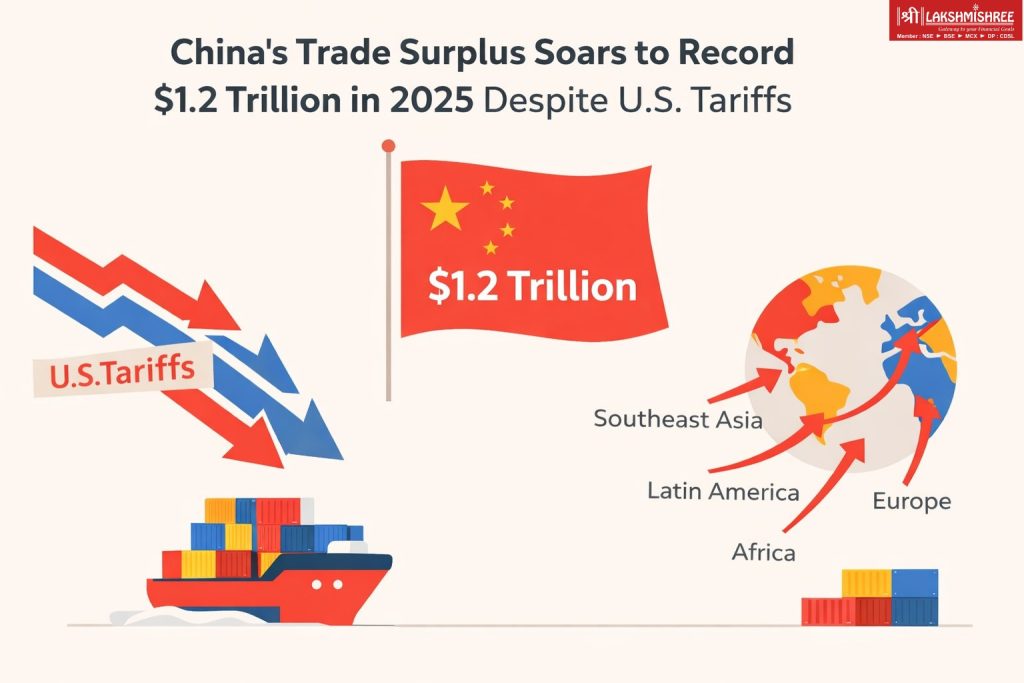
China closed 2025 with an unprecedented trade surplus of nearly $1.2 trillion, the largest annual trade surplus ever recorded by any country, underscoring the resilience of its export-led growth model even under renewed tariff pressures from the United States.
Exports Remain Strong, Imports Lag
Customs data show that China’s exports rose about 5.5–6.6 percent in 2025, driven by robust global demand and strategic market diversification. Total export value reached around $3.77 trillion for the year, while imports were significantly lower at approximately $2.58 trillion. The gap between foreign sales and inbound purchases pushed the trade surplus sharply upwards compared with $992 billion in 2024.
December ended the year on a particularly strong note, with exports up 6.6 percent year-on-year and imports rising 5.7 percent, reinforcing an export momentum that sustained China’s external account strength toward the end of the year.
Diversifying Markets Offset US Slowdown
The global trade landscape for China last year was marked by sharp declines in exports to the United States, a trend widely linked to higher trade barriers and tariffs imposed after Donald Trump’s return to the presidency. U.S.-bound shipments fell by as much as 20 percent, reflecting reduced cost competitiveness and tariff avoidance efforts by buyers.
However, exporters in China sharply pivoted toward markets in Southeast Asia, Africa, Latin America and the European Union, where demand for Chinese manufactured goods grew strongly. Shipments to Africa expanded by more than 25 percent, while Southeast Asian exports climbed by over 13 percent. Exports to the EU and Latin America also registered healthy gains.
This geographic shift helped offset the U.S. slowdown, ensuring that overall export growth remained positive.
Structural Drivers of Export Resilience
China’s record surplus reflects a convergence of factors that have strengthened its global trade position:
- Manufacturing Scale and Capabilities: China maintains deep industrial capacity across electronics, vehicles, machinery, and renewable technology components. Exported vehicle shipments grew significantly, with electric vehicle volumes among the fastest-expanding categories.
- Global Supply Chain Integration: Chinese production hubs continue to feed global manufacturers, with many firms either sourcing from China or establishing regional assembly lines that still depend on Chinese parts and components.
- Currency Dynamics: A relatively softer yuan relative to key currencies such as the euro has helped preserve export price competitiveness, even as global inflation varied across trading partners.
- Weak Domestic Demand: Slow growth in household consumption and business investment — partly linked to a prolonged property sector downturn — dampened import demand, widening the external gap.
Broader Global Trade Implications
China’s outsized surplus and export strength in 2025 have contributed to persistent global trade imbalances. Economies that compete directly with China in manufacturing sectors, such as electronics and autos, have expressed concern that large inflows of lower-priced Chinese goods can strain domestic producers and exacerbate trade deficits elsewhere.
In response to international unease, Chinese policymakers have taken tentative steps to moderate export incentives, including phasing out certain tax rebates on solar panels and batteries, a long-standing point of international contention. Discussions about balancing exports with increased imports and domestic demand have also gained traction among authorities as part of longer-term economic strategy adjustments.
Geopolitical and Trade Policy Context
Although China’s export performance has defied expectations under U.S. tariff pressure, the bilateral trade relationship remains complex. Tariff threats and trade policy shifts — including new levies on trading partners linked to broader geopolitical objectives — continue to shape export strategies on both sides. Meanwhile, supply chains are evolving as firms and countries seek to reduce dependency on any single export hub, including through regional trade agreements and localized manufacturing networks.
China’s surplus also drew international commentary on the need to rebalance growth drivers. Global institutions have highlighted the long-term risk of an economy excessively reliant on exports while domestic consumption and investment remain subdued, emphasizing that a transition toward balanced growth could reduce external pressures and trade frictions.
What to Expect in 2026
Looking ahead, economists forecast that exports will remain a key growth pillar for China in 2026, though gains may moderate as high base effects and intensifying trade barriers limit acceleration. Continued expansion into diversified markets abroad, together with adjustments in global supply chain sourcing, is expected to keep Chinese trade flows robust. However, geopolitical tensions and the evolution of tariff regimes will remain significant variables influencing trade outcomes.
In summary, China’s historic $1.2 trillion trade surplus in 2025 illustrates how exporters have adapted quickly to shifting global demand and tariff landscapes, leveraging diversified markets and deep manufacturing capability to sustain strong external performance even amid persistent geopolitical challenges.

Kaashika is a social media strategist and financial content creator at Lakshmishree. She specialises in simplifying complex IPO and stock market concepts into clear, easy-to-understand content. Having created over 500+ pieces of financial content across reels, blogs, website posts and digital creatives, Kaashika helps audiences connect with the world of finance in a more accessible and engaging way.