India’s long-anticipated trade agreement with the United States remains unresolved, with new comments from US Commerce Secretary Howard Lutnick bringing diplomatic dynamics into sharp focus. The development comes at a sensitive moment, as Washington simultaneously advances a hard-line sanctions bill that could materially affect Indian exports and energy trade.
What the US Commerce Secretary Said about India–US Trade Deal
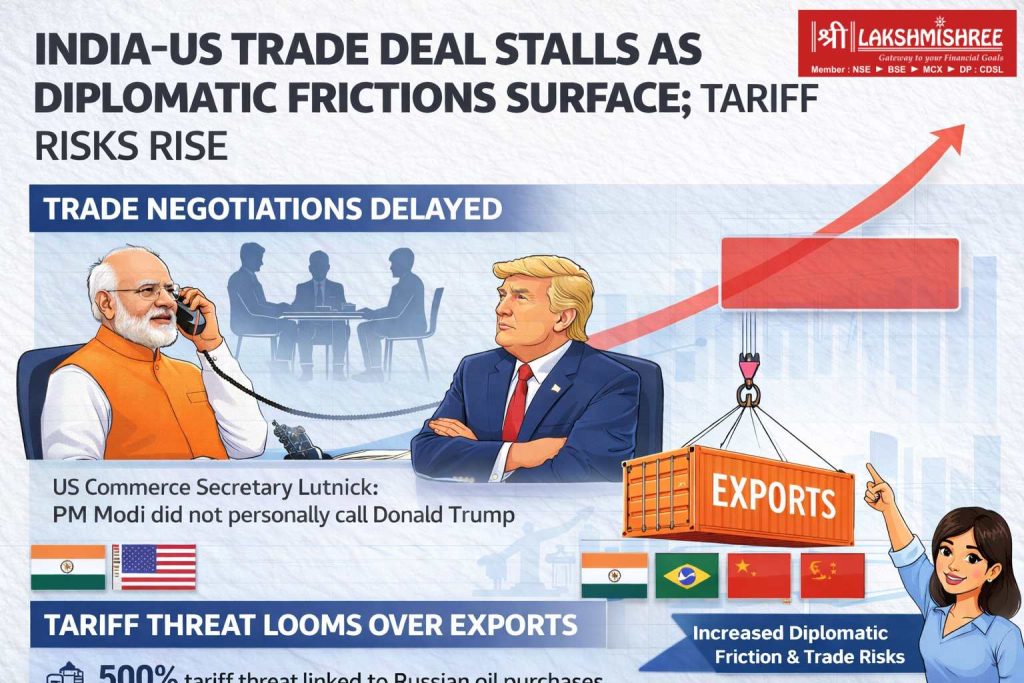
In a recent podcast appearance with investor Chamath Palihapitiya, US Commerce Secretary Howard Lutnick claimed that the India–US trade deal stalled because Prime Minister Narendra Modi did not personally call US President Donald Trump.
“I set the deal up. But you had to have Modi call President Trump. They were uncomfortable with it. So, Modi didn’t call,” Lutnick said.
Lutnick added that the US had assumed India’s deal would be finalised earlier than agreements with countries such as Indonesia, Vietnam, and the Philippines. However, as those negotiations progressed at higher tariff levels, India, according to him, sought to renegotiate terms.
The Indian government has not officially responded to these remarks so far.
Why the Statement Matters
While diplomatic engagements are often conducted through established institutional channels, Lutnick’s comments suggest that personal leader-level engagement is being framed by the Trump administration as a critical factor in trade negotiations.
From India’s perspective, trade discussions are typically handled through:
- Ministry of Commerce & Industry
- Dedicated trade negotiators
- Bilateral working groups and institutional mechanisms
The absence of a public Indian response indicates New Delhi’s preference to avoid escalating what it may see as an informal or political interpretation of a formal trade process.
The Bigger Context: Russia Sanctions and India–US Trade Deal Tariff Threats
The timing of Lutnick’s comments is significant. They follow US President Donald Trump’s approval of a bipartisan Russia Sanctions Bill, which proposes punitive tariffs of up to 500% on countries that continue to purchase Russian oil and commodities.
Key elements of the proposed legislation include:
- Tariffs of at least 500% on imports from Russia
- Expanded presidential authority to penalise Russia’s trading partners
- Potential inclusion of India, China, and Brazil due to energy purchases
Republican Senator Lindsey Graham, one of the bill’s sponsors, said the objective is to apply economic pressure on countries “fueling Russia’s war machine.”
India’s Position on Russian Oil
India has consistently maintained that its energy purchases are guided by national interest and energy security, especially amid global supply disruptions.
New Delhi has rejected claims that it committed to halting Russian oil imports, emphasising:
- Oil procurement is market-driven
- Decisions are based on price stability and domestic inflation control
- India is not in violation of any international law or UN-mandated sanctions
Market Impact Already Visible
Even before the bill becomes law, market volatility has increased.
Export-oriented stocks—particularly in:
- Textiles
- Shrimp and seafood
- Engineering exports
have seen sharp declines, reflecting investor anxiety over potential access restrictions to the US market.
Companies with a high revenue dependence on the US are particularly vulnerable if tariffs or sanctions escalate beyond rhetoric.
Is the India–US Trade Deal Truly “Off”?
At present, no official confirmation exists from either side that negotiations have collapsed. What is evident is:
- Diplomatic tone has hardened
- Trade talks are increasingly linked to geopolitical positioning
- Economic negotiations are no longer isolated from strategic considerations
Trade experts note that even if the current framework stalls, sector-specific arrangements, tariff exemptions, or phased agreements remain possible.
Strategic Takeaway
What is unfolding is less about a single phone call and more about a shift in how trade, diplomacy, and geopolitics intersect under the current US administration.
For India:
- Maintaining policy autonomy on energy remains non-negotiable
- Export diversification will become increasingly critical
- Diplomatic engagement may need recalibration, not reaction
For markets:
- Policy risk is now a core variable in export-oriented valuations
- Trade headlines will continue to drive short-term volatility
Conclusion
The India–US trade deal remains in limbo—not formally abandoned, but clearly complicated by diplomatic signalling and broader geopolitical pressures. With sanctions legislation advancing and trade negotiations becoming more personalised, the coming weeks will be crucial in determining whether pragmatism prevails over political posturing.
For now, both governments appear to be keeping doors open for India–US Trade Deal, even as pressure mounts on the negotiating table.

Kaashika is a social media strategist and financial content creator at Lakshmishree. She specialises in simplifying complex IPO and stock market concepts into clear, easy-to-understand content. Having created over 500+ pieces of financial content across reels, blogs, website posts and digital creatives, Kaashika helps audiences connect with the world of finance in a more accessible and engaging way.