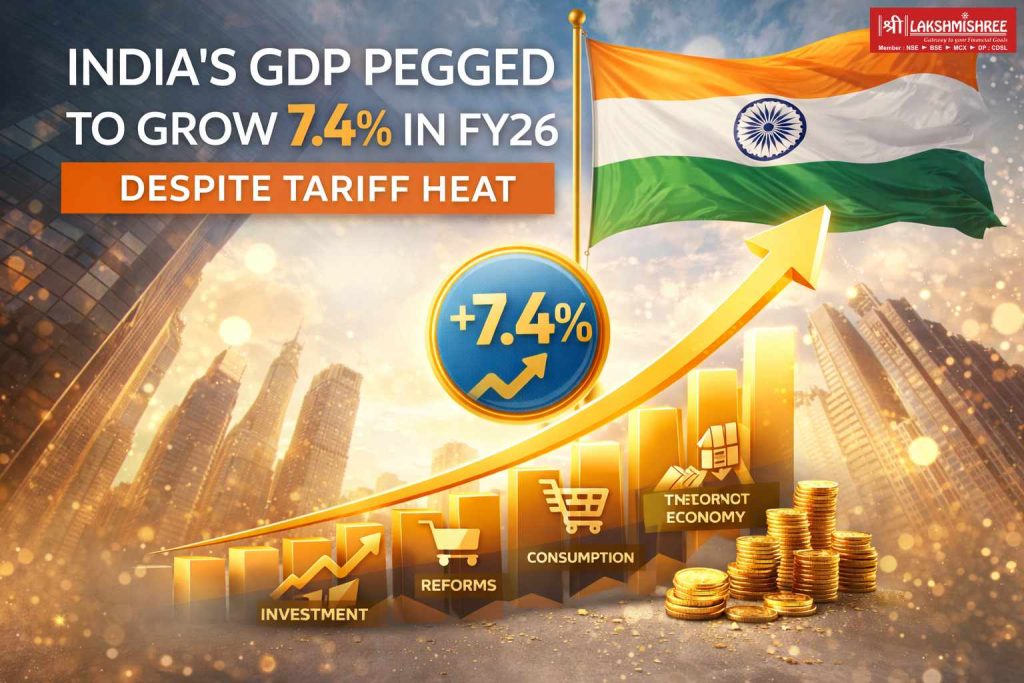
India is expected to remain one of the world’s fastest-growing major economies in FY26, with gross domestic product (GDP) projected to expand by 7.4%, according to official government estimates released on Wednesday. The forecast highlights the economy’s resilience at a time when global growth is slowing, financial conditions are tight, and trade uncertainty has resurfaced due to renewed tariff pressures from the United States.
The projection is higher than the Reserve Bank of India’s (RBI) latest estimate of 7.3%, and significantly above last year’s 6.5% growth, reinforcing India’s position as a relative outperformer among large economies. These growth assumptions will serve as the macroeconomic base for the Union Budget 2026, scheduled to be presented on February 1.
Strong Momentum Builds Into INDIA’s GDP FY26
India’s economic momentum strengthened notably in the second quarter of FY26. GDP growth accelerated to a six-quarter high of 8.2%, surpassing market expectations and improving from 7.8% in the April–June quarter. This rebound suggests that the slowdown witnessed in parts of FY25 was cyclical rather than structural.
Over the past three fiscal years, India’s growth trajectory has shown resilience amid volatility:
- FY24: 6.5%
- FY25: 9.2%
- FY26 (projected): 7.4%
While growth is moderating from the post-pandemic surge, it remains robust and broad-based, supported by domestic demand, investment revival, and targeted fiscal intervention.
Nominal GDP Growth Moderates, But Remains Healthy
Nominal GDP—reflecting both real growth and inflation—is expected to grow by 8% in FY26, down from 9.7% in the previous fiscal year. The moderation reflects easing inflationary pressures rather than weakening economic activity.
Lower inflation has created space for policy stability, helped maintain purchasing power, and reduced macro risks—an important contrast to many advanced economies still grappling with sticky price pressures.
Domestic Engines Power Growth
1. Services Sector Remains the Anchor
India’s services sector continues to be the backbone of growth, contributing more than 55% of GDP. IT services, financial services, trade, transport, and professional services have shown consistent expansion, driven by digital adoption, rising formalisation, and strong urban demand.
Despite global tech spending caution, India’s IT exports have remained resilient due to diversified client bases and higher-value services such as cloud migration, AI integration, and cybersecurity.
2. Investment Cycle Gathers Pace
Capital expenditure remains a key growth driver. Government-led infrastructure spending—on roads, railways, defence manufacturing, renewable energy, and urban development—has crowded in private investment.
Indicators such as:
- Rising capacity utilisation
- Improved corporate balance sheets
- Strong bank credit growth (above 14% YoY)
suggest that India is entering a durable investment upcycle, particularly in manufacturing, logistics, and energy transition projects.
3. Consumption Boosted by Tax Relief and GST Cuts
A crucial support to growth has come from policy-led consumption revival. During FY26, the government rolled out:
- Income tax relief for the middle class
- GST rate reductions across a wide range of products from September 22
These measures lowered retail prices and increased disposable income, particularly for urban households. Industry executives noted a visible improvement in demand for discretionary items, automobiles, consumer electronics, and services following the tax changes.
Industrial Output and Credit Flows Improve
Industrial production has picked up steadily, supported by:
- Strong performance in capital goods and infrastructure-linked sectors
- Improved credit availability
- Lower stress in the banking system
With non-performing assets at multi-year lows and capital adequacy at comfortable levels, banks are well-positioned to fund growth. MSME lending, housing finance, and industrial credit have emerged as key growth segments.
Global Risks Persist, But Impact Contained
India’s growth outlook remains resilient despite global uncertainties. Renewed tariff tensions—particularly under the Trump administration’s trade stance—have raised concerns about global supply chains and export demand.
However, India’s lower dependence on exports compared to East Asian economies, combined with a strong domestic market, provides insulation. Moreover, supply-chain diversification away from China continues to benefit India through increased manufacturing inflows and export opportunities.
Structural Reforms Provide Long-Term Support
India’s growth durability is also rooted in structural reforms undertaken over the past decade:
- Goods and Services Tax (GST) integration
- Insolvency and Bankruptcy Code (IBC)
- Digital public infrastructure (UPI, Aadhaar, ONDC)
- Production-Linked Incentive (PLI) schemes
These reforms have improved productivity, reduced transaction costs, and strengthened formal economic activity, laying a strong foundation for sustainable growth.
What It Means for the Budget and Markets
The 7.4% growth assumption gives the government fiscal headroom ahead of Budget 2026. Higher growth improves tax collections, supports deficit consolidation, and allows continued spending on infrastructure and social priorities without destabilising public finances.
For markets, the data reinforces confidence in:
- India’s medium-term growth story
- Earnings visibility across sectors
- Relative attractiveness of Indian assets amid global uncertainty

Kaashika is a social media strategist and financial content creator at Lakshmishree. She specialises in simplifying complex IPO and stock market concepts into clear, easy-to-understand content. Having created over 500+ pieces of financial content across reels, blogs, website posts and digital creatives, Kaashika helps audiences connect with the world of finance in a more accessible and engaging way.